说
Character Story & Explanation
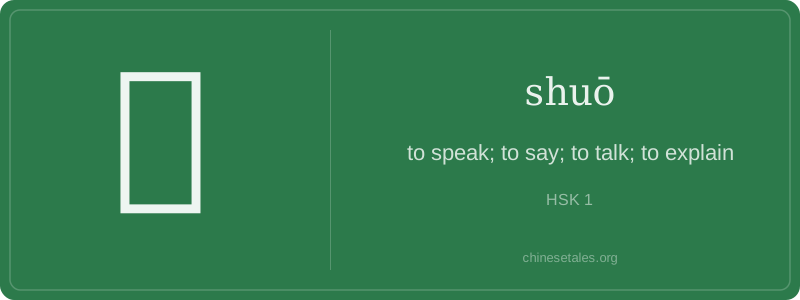
The earliest form of 说 appears in bronze inscriptions around 1000 BCE as a compound pictograph: on the left, a stylized mouth (口), and on the right, a hand offering something — later evolving into 兑, which depicted two people exchanging goods or words. By the Qin dynasty, the mouth radical simplified into 讠 (a vertical stroke plus a dot-and-hook), while 兑 standardized into its modern shape — still echoing ‘exchange’ through its ancient meaning of ‘to fulfill’ or ‘to deliver’. Stroke by stroke, the nine strokes trace a journey from physical gesture (mouth + hand) to abstract communication (speech + reciprocity).
By the Han dynasty, 说 had solidified its core meaning in texts like the *Analects*, where Confucius praises those who ‘say little but do much’ (君子欲讷于言而敏于行). Interestingly, classical Chinese also used 说 as a noun meaning ‘explanation’ or ‘interpretation’ — as in 《孟子》's ‘说诗者’ (shuō shī zhě, ‘those who interpret poetry’). That scholarly nuance survives today in academic compounds like 解说 (jiěshuō, ‘commentary’), linking ancient hermeneutics to modern podcast hosts.
At its heart, 说 (shuō) is the verb for *voicing thoughts* — not just uttering sounds, but actively communicating meaning: saying, speaking, explaining, even arguing. It’s not passive (like ‘being spoken’) — it’s always intentional and agent-driven. The left side 讠 (the ‘speech’ radical) instantly flags this as language-related, while the right side 兑 (duì) originally meant ‘to exchange’ or ‘to open up’ — think of speech as an exchange of ideas, or opening your mouth to let words out. That dual sense — speech + exchange — is baked into every use.
Grammatically, 说 is wonderfully flexible. You can say something directly (我说中文||wǒ shuō zhōngwén), report speech (他说他很忙||tā shuō tā hěn máng), or use it in fixed patterns like ‘shuō de duì’ (‘that’s right!’). A classic learner trap? Forgetting that 说 always takes a direct object or clause — you don’t just ‘speak’ abstractly; you ‘speak Chinese’, ‘say hello’, or ‘say that he’s coming’. Also, note: it’s almost never used alone as a noun — unlike English ‘a speech’, we’d use 演讲 (yǎnjiǎng) instead.
Culturally, 说 carries subtle weight: in Confucian tradition, ‘right speech’ (正言 zhèng yán) is one of the Five Virtues — speaking truthfully, kindly, and purposefully. So when someone says ‘别乱说!’ (bié luàn shuō! — ‘Don’t speak carelessly!’), it’s not just about grammar — it’s a moral nudge. Learners often overuse 说 where English uses ‘tell’, but tell requires a listener (e.g., 告诉 gào·sù), while 说 focuses on the act of articulation itself.