远
Character Story & Explanation
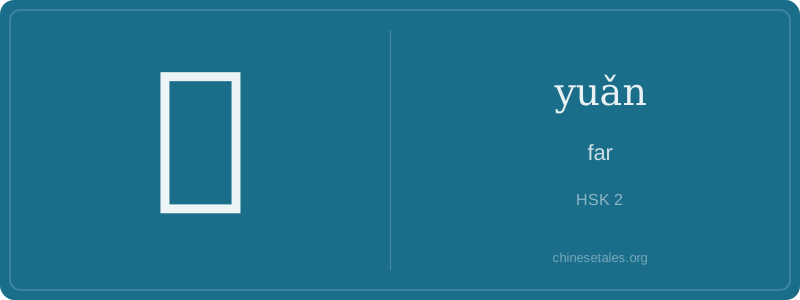
The earliest form of 远 appears in bronze inscriptions as a combination of 辵 (chuò, later simplified to 辶 — the 'walking' radical) and 袁 (yuán), which originally depicted a person wearing loose, flowing robes — suggesting movement *away* from the center. The left side evolved: 袁’s top part (厶) and middle (衣) simplified into the modern 元, while the walking radical 辶 solidified as three strokes beneath — a clear visual metaphor: 'a person in motion, heading outward.' By the seal script era, the structure stabilized into today’s seven-stroke form: the top 元 (4 strokes) + bottom 辶 (3 strokes), embodying departure through both sound and shape.
This visual logic deepened over time: in the Analects, Confucius says 君子务本,本立而道生 (jūnzǐ wù běn, běn lì ér dào shēng) — 'the noble person devotes himself to the root; with the root established, the Way arises.' Here, 远 subtly underpins the idea that ethical cultivation begins by *distancing oneself* from superficiality — making 远 not just spatial, but philosophical. Its enduring shape — a person (元) stepping away (辶) — remains a quiet reminder that in Chinese thought, true progress often begins with deliberate distance.
At its heart, 远 (yuǎn) isn’t just a neutral measurement like 'far' in English — it carries emotional weight and relational nuance. In Chinese, distance isn’t only physical; it’s moral, temporal, and affective. Saying 他离我很远 (tā lí wǒ hěn yuǎn) can mean he lives across the country *or* that we’ve grown emotionally estranged — context decides. This dual physical/abstract use is baked into the language: 远 is equally at home describing a mountain range and a generation gap.
Grammatically, 远 is an adjective but rarely stands alone. It almost always appears with degree words (很, 太, 非常) or in comparative structures (比…远). Crucially, it *doesn’t* take 的 before nouns — you say 远方 (yuǎnfāng, 'distant place'), not *远的方. Learners often wrongly insert 的 or try to use 远 as a verb ('to far'), but it’s strictly descriptive. Also, while 远 can modify verbs indirectly (e.g., 走得很远), it never directly modifies them like English adverbs — no *远走, only 走远 (a compound verb meaning 'to go far away').
Culturally, 远 reflects the Confucian ideal of measured relational space: respect requires appropriate distance — hence phrases like 敬而远之 (jìng ér yuǎn zhī, 'respect but keep at a distance'). A common mistake? Using 远 when you need 长 (cháng) for 'long' (time/distance) — 远 is *spatial* or *relational* distance, not duration. And yes — that rare yuàn reading appears only in classical compounds like 怨 (yuàn, 'to resent'), where 远 was once a phonetic component; modern learners can safely ignore it outside advanced literary study.