铅
Character Story & Explanation
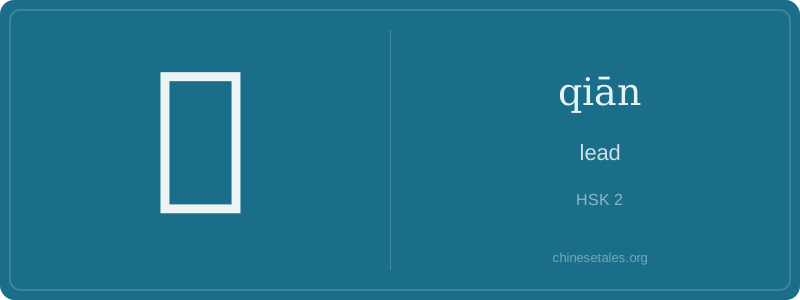
The earliest form of 铅 appears on Warring States bamboo slips (c. 475–221 BCE), not oracle bones — because lead wasn’t widely used until later metallurgical advances. Its original structure combined the metal radical (金, later simplified to 钅) with the phonetic component 沿 (yán), which suggested pronunciation. Over centuries, 沿 was gradually simplified: the water radical (氵) dropped, the 'mouth' (口) shrank, and the 'boat' (舟) morphed into the two horizontal strokes and hook at the bottom — giving us today’s 10-stroke 铅. Visually, it’s a metal radical anchored by something that looks like a sinking weight — fitting for the densest common metal known to ancient China.
Historically, lead fascinated early Chinese alchemists — it was one of the 'Five Metals' (alongside gold, silver, copper, and iron) and featured in Daoist elixirs (often disastrously). The Shuōwén Jiězì (121 CE) defines it as 'a heavy metal, soft and malleable, used for casting weights and seals'. By the Tang dynasty, lead white (铅粉, qiān fěn) became the standard cosmetic for pale skin — a beauty ideal so entrenched that 'washing off lead powder' (洗铅华) came to mean shedding worldly vanity. Even today, the character’s visual heft echoes its ancient reputation: unglamorous, essential, quietly dangerous.
At first glance, 铅 (qiān) means 'lead' — the heavy, soft, bluish-gray metal — but in Chinese, it’s rarely discussed for its industrial uses. Instead, it lives most vividly in the phrase 铅笔 (qiān bǐ), literally 'lead pen', even though modern pencils contain graphite, not lead! This reflects how Chinese lexical memory preserves historical truth: when early Western pencils arrived in China, people assumed the dark core was lead (a common misconception globally), and the name stuck — a charming fossil of cross-cultural misidentification.
Grammatically, 铅 is almost always a noun and appears either as a standalone term (e.g., '铅有毒' — 'lead is toxic') or in compounds. It doesn’t function as a verb or adjective — no 'to lead-ify' or 'lead-like' derivations. Learners sometimes wrongly treat it like English 'lead' (as in /liːd/), but here it’s only /qiān/, with no homophone ambiguity in speech. Also, unlike English, you’d never say 'lead poisoning' as *'lead poison' — it’s always 铅中毒 (qiān zhòng dú), where 中毒 is an inseparable compound meaning 'to be poisoned'.
Culturally, 铅 carries quiet gravity — not just physically, but symbolically. In classical texts, it represented heaviness, dullness, or stagnation (e.g., '铅华' — qiān huá — 'powdered lead', an ancient cosmetic that evolved to mean 'superficial beauty' or 'worldly adornment'). Modern learners often mispronounce it as *qián (like 钱), but the tone is firmly first — think: 'QIĀN is the weighty one, not the wealthy one!'