阴
Character Story & Explanation
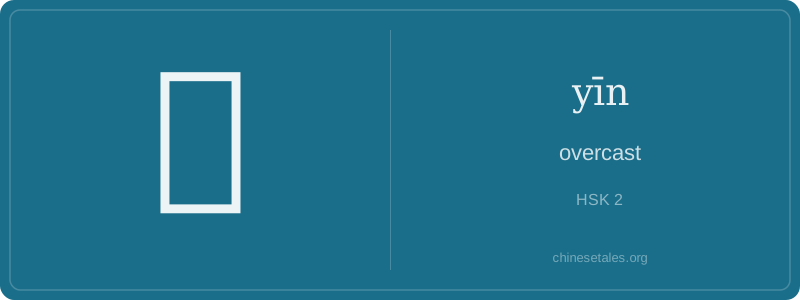
The earliest form of 阴 appears in bronze inscriptions around 1000 BCE as a combination of two elements: 今 (a phonetic hint, later simplified to 月) and 阝 (the 'hillside' or 'mound' radical, originally ⻏ — a pictograph of a hill with a path curving beside it). In oracle bone script, it wasn’t yet standardized, but the core idea was clear: a hill *shaded* — specifically, the north-facing slope, which receives no direct sunlight. Over centuries, the left side evolved from 今 to 月 (moon), reinforcing the association with shade, coolness, and absence of sun — even though the moon itself isn’t always visible on overcast days!
This geographical origin — the *north side of a hill* — became metaphorical shorthand for all things shaded, cool, hidden, or passive. By the time of the *Zhuangzi* and *Yijing*, 阴 had crystallized into one half of the Yin-Yang cosmology. Yet remarkably, its everyday meaning never lost touch with its roots: an overcast sky literally shades the earth just as the north slope of a hill does. The character’s shape — a ‘hill’ (阝) next to ‘moon’ (月) — silently tells this story: not the sun’s domain, but the realm of gentle, cloud-filtered light.
Imagine you’re hiking up a misty mountain in Guilin. The sun vanishes behind thick, slow-moving clouds — not stormy, not rainy, just soft, diffused, and quietly dim. That’s the feeling of 阴 (yīn): not darkness, not night, but *overcast* — the gentle hush of light muted by cloud cover. It’s the weather that makes your shadow disappear and gives everything a silver-gray glow. This isn’t just meteorology; it’s a sensory mood deeply embedded in Chinese perception of atmosphere and balance.
Grammatically, 阴 most commonly appears as an adjective before nouns (e.g., 阴天 yīn tiān — 'overcast day') or in compound words like 阴影 (yīn yǐng, 'shadow'). It rarely stands alone in speech — you won’t say *‘Today is yīn’* without context. Learners often mistakenly use it for ‘dark’ (which is 黑 hēi) or confuse it with ‘gloomy’ (which carries emotional weight — 阴郁 yīn yù — a different register entirely). Remember: 阴 describes *light quality*, not brightness level or emotion.
Culturally, 阴 is inseparable from its cosmic counterpart, 阳 (yáng) — together they form the foundational duality of Daoist thought: shaded vs. sunlit, receptive vs. active, feminine vs. masculine. But at HSK 2? Stick to weather. Don’t overthink the philosophy — yet. Just picture that misty mountain, and when you see 阴, feel the cool, quiet hush of cloud-covered light.