用
Character Story & Explanation
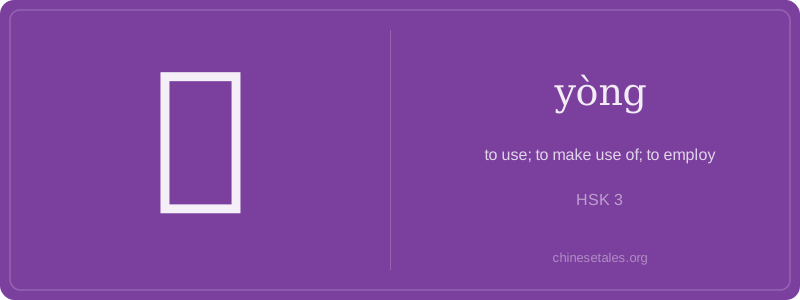
The earliest form of 用 in oracle bone script (c. 1200 BCE) looked like a stylized, upright rectangular frame — possibly representing a ceremonial bronze vessel (like a yǒng 鬲) viewed from above, with two handles and a hollow center. Over centuries, the top and bottom horizontal strokes solidified, the inner verticals simplified, and the sides became clean, parallel lines — evolving through bronze inscriptions and seal script into the modern five-stroke shape: a tidy, self-contained rectangle with a centered vertical stroke dividing it — visually echoing containment, structure, and purposeful enclosure.
This vessel origin wasn’t arbitrary: ancient ritual bronzes were *used* — for offerings, ceremonies, storage — making 用 inherently tied to *function through form*. By the Warring States period, texts like the *Zuǒ Zhuàn* already used 用 broadly: ‘用人’ (employ people), ‘用兵’ (wage war), showing how early the character shifted from concrete object-use to abstract application of resources, talent, or force. Its clean, balanced shape — no flairs, no curves — mirrors its semantic role: efficient, direct, no-nonsense utility. Even today, that centered vertical stroke feels like the ‘axis’ around which purpose rotates.
At its heart, 用 (yòng) isn’t just ‘to use’ — it’s about *purposeful activation*. Think of it as flipping a switch: something inert becomes functional, intentional, alive with intent. Unlike English ‘use’, which can be neutral or even negative (‘He used me’), 用 in Chinese carries an implicit sense of utility, efficiency, and appropriateness — you don’t just ‘use’ a tool; you 用 it *for a reason*, often with care or skill. That’s why you’ll hear ‘用手机打电话’ (use phone to call), not just ‘use phone’.
Grammatically, 用 is wonderfully flexible: it’s a verb (我用铅笔写字), but also appears in the very common ‘用…来…’ structure meaning ‘use X to do Y’ (我们用筷子来吃饭). Crucially, it *never* takes aspect particles like 了 or 过 directly — you say ‘我用了这个方法’ (I used this method), not ‘我用过了’ (that’s grammatically off — you’d say ‘我试过这个方法’ instead). Learners often overgeneralize 用 like English ‘use’, leading to awkward phrasing like ‘用谢谢’ — nope! ‘谢谢’ stands alone; 用 doesn’t attach to expressions of gratitude.
Culturally, 用 reflects a pragmatic, results-oriented mindset — it’s embedded in phrases like ‘学以致用’ (learn in order to apply), a Confucian ideal stressing knowledge must serve real-world function. Also, notice how often 用 appears in bureaucratic or technical contexts (用途, 用量, 用处): it’s the character of engineers, teachers, and planners — not poets or dreamers. That’s why mastering 用 means stepping into the rhythm of how Chinese speakers *get things done*.