种
Character Story & Explanation
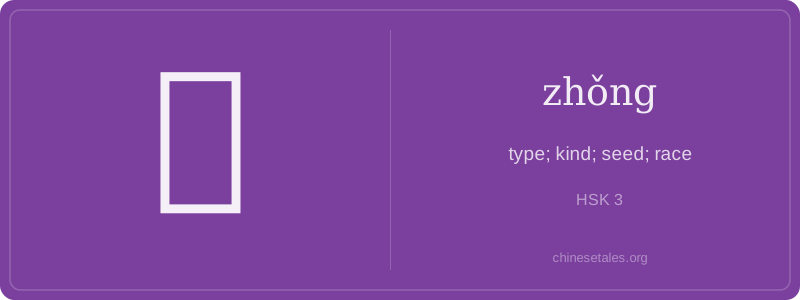
The earliest form of 种 appears in bronze inscriptions as a combination of 禾 (grain stalk) on the left and 重 (heavy, later simplified to 中+丶) on the right — not as a phonetic placeholder, but as a semantic amplifier: heavy grain = fertile, viable seed. Over time, the right side streamlined from 重 to 中 with a dot (丶) above, preserving the idea of ‘substance that carries life forward’. The nine strokes we write today — starting with the 禾 radical’s distinctive ‘sprout-and-stalk’ stroke order — visually echo a seed nestled in earth: the horizontal stroke of 中 acts like soil, the dot above like the emerging shoot.
This visual logic shaped its meaning evolution: from tangible ‘grain seed’ in Shang dynasty oracle bones, to ‘lineage’ in Zhou bronze inscriptions (‘descendants as living seeds of ancestors’), then to abstract ‘category’ by the Han dynasty — seen in the Shuōwén Jiězì (100 CE), which defines it as ‘the beginning of life, the root of all things’. Even Confucius used ‘rén zhǒng’ (human race) to stress shared moral potential — treating humanity itself as a cultivable crop. The character never lost its quiet urgency: every 种 implies growth, inheritance, and choice.
Imagine you’re at a bustling Beijing farmers’ market, holding a small paper bag of sunflower seeds — ‘guāzǐ’ — and the vendor says, ‘Zhè shì yī zhǒng xīn de guāzǐ!’ (This is a new kind of sunflower seed!). That little word zhǒng does double duty here: it’s both the literal ‘seed’ in your hand *and* the abstract ‘kind’ or ‘type’ describing its novelty. That duality — concrete seed + abstract category — is the heart of 种. It’s not just ‘a type’ like English ‘kind’; it carries agricultural weight, biological lineage, and even cultural identity (as in ‘rén zhǒng’, race).
Grammatically, 种 is most often a measure word for kinds/types — always paired with a number or demonstrative: ‘yī zhǒng’, ‘zhè zhǒng’, ‘nà zhǒng’. Unlike English, you can’t say ‘three kinds’ without the measure word — saying *sān zhǒng* is mandatory. And crucially: when used as a noun meaning ‘seed’, it’s almost always in compounds like ‘zhǒngzi’ (not standalone); alone, it leans strongly toward ‘type/race’. Learners often overuse it as a free-standing noun meaning ‘seed’ — but native speakers say ‘zhǒngzi’ or ‘xìngzhǒng’ for clarity.
Culturally, 种 reflects China’s agrarian roots — the禾 radical isn’t decorative; it anchors the character in grain cultivation. In classical texts like the Mencius, ‘zhǒng’ appears in metaphors about human nature being like seeds needing proper soil — a nuance still alive today. Also, watch the tone: zhǒng (third tone) means ‘type/seed/race’, while zhòng (fourth tone) is the verb ‘to plant’ — same character, different life! Mixing them up turns ‘I planted rice’ into ‘I am a kind of rice’.