业
Character Story & Explanation
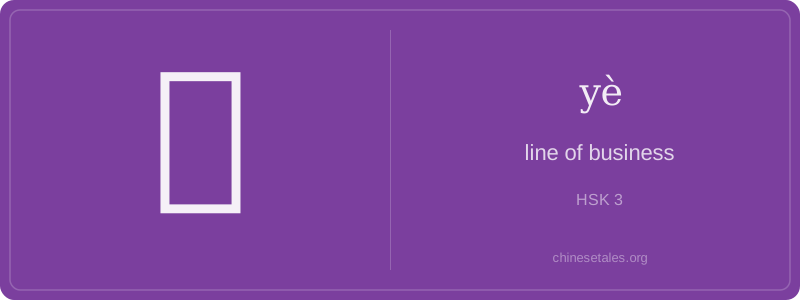
The earliest form of 业 appears in bronze inscriptions as two parallel horizontal lines crossed by two shorter vertical strokes — resembling a wooden rack or loom beam used in weaving. That original pictograph depicted a sturdy framework holding threads under tension: a symbol of structure, craft, and disciplined labor. Over centuries, the verticals simplified, the top and bottom lines thickened, and the middle crossbars faded — leaving today’s clean, minimalist five-stroke form: 一 (top), 丨 (left), 丨 (right), 一 (middle), 一 (bottom). Though stripped of detail, the essence remains: horizontal stability supporting vertical effort.
This ‘loom frame’ evolved metaphorically into ‘what one undertakes’: first agricultural plots (landholding), then skilled trades, then scholarly pursuits, and finally — in Buddhist texts like the *Avataṃsaka Sūtra* — ‘karma’ as intentional action. Confucius used yè to describe moral cultivation: ‘A gentleman is not a vessel’ — he doesn’t just hold knowledge, but *embodies his yè*. Even today, when Chinese parents ask ‘nǐ de yè shì shén me?’ (What’s your line of work?), they’re asking not just ‘what do you do?’ but ‘what have you chosen to cultivate?’
At its heart, 业 (yè) isn’t just ‘business’ — it’s about *what you do with your life*: your craft, calling, profession, or even spiritual practice. Think of it as the Chinese word for ‘vocation’ with a quiet weight — not just a job title, but something you invest in, build, and carry. You’ll see it everywhere: in rén yè (‘career’), xué yè (‘field of study’), and even zào yè (‘to create karma’ — yes, that’s the same 业!). It’s deeply tied to effort and consequence.
Grammatically, 业 is almost always a noun and appears in compound words — rarely standalone. Learners often mistakenly try to use it like English ‘business’ in sentences like *‘I do business’* — but you wouldn’t say *wǒ zuò yè*. Instead, you’d say wǒ cóng shì jiāo yù yè (‘I work in the education field’) or zhè shì wǒ de běn yè (‘This is my main line of work’). Notice how it’s embedded in compounds — never verb-like.
Culturally, 业 carries echoes of Buddhist thought: karma (yè) is literally ‘action’ that ripens into consequence — and this idea seeped so deeply into daily language that even ‘industry’ or ‘profession’ feels like a kind of karmic footprint. A common slip? Confusing 业 with yǐ (already) or yì (meaning/idea) — both sound similar but are visually and semantically worlds apart. Remember: 业 is grounded, horizontal, and purposeful — like a foundation slab.