学
Character Story & Explanation
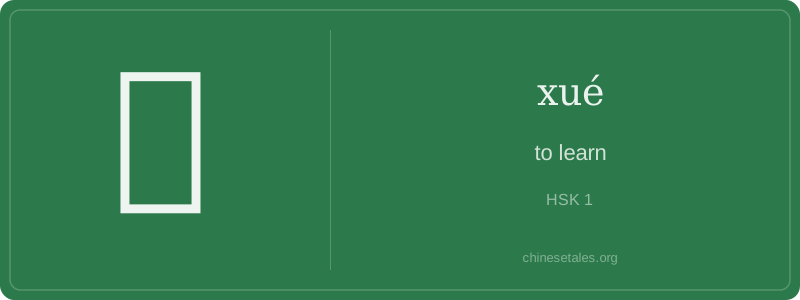
The earliest form of 学 appears on oracle bones as two hands holding a child (子) inside a roofed enclosure — a pictograph of ‘instruction under shelter’. By the bronze script era, the roof evolved into the top component (宀 mián), the hands became the crossed strokes (×) now embedded in the upper left, and the child remained as the bottom radical 子. Over centuries, the hands simplified into the two diagonal strokes (⺈) flanking the top, and the roof smoothed into the clean 宀 — giving us today’s elegant 8-stroke structure: 宀 + × + 子. Every stroke tells a story of guidance, protection, and generational transmission.
This visual logic shaped its meaning deeply: 学 wasn’t just acquiring facts — it was apprenticing within a protected, relational space. In the Analects, Confucius says ‘学而不思则罔’ (‘Learning without thinking leads to confusion’), reinforcing that 学 must be paired with reflection. Even today, the character’s composition reflects this philosophy: the roof (宀) shelters the learner (子), while the crossed strokes suggest dialogue, exchange, or the bridging of teacher and student. It’s no accident that 学 appears in words like 学校 (school) and 学问 (scholarship) — places and practices where knowledge is passed down, not downloaded.
At its heart, 学 (xué) isn’t just ‘to learn’ — it’s the active, humble, lifelong posture of opening yourself to knowledge. Think of it as a verb with built-in respect: you don’t just absorb facts; you *submit* to a teacher, a tradition, or even experience itself. That’s why it almost always appears with an object (学中文 xué Zhōngwén — 'learn Chinese') or a purpose (学开车 xué kāichē — 'learn to drive'). Unlike English ‘learn’, which can stand alone ('I learn fast'), 学 feels incomplete without what’s being learned — a subtle but crucial grammatical nudge toward intentionality.
Grammatically, it’s beautifully straightforward at HSK 1: subject + 学 + [object]. No conjugations, no tenses — just add 了 (le) for completed action (我学了三个字 wǒ xué le sān gè zì — 'I learned three characters') or 在 (zài) for ongoing action (我在学 wǒ zài xué — 'I’m learning'). Watch out for overusing 我在学习 (wǒ zài xuéxí) — while correct, native speakers often drop the formal 学习 and say 我在学 for everyday contexts. Also, never say *学 + person* ('learn John') — that’s a classic fossilized error. You 学 from someone (跟老师学 gēn lǎoshī xué), not *学* them.
Culturally, 学 carries quiet weight: it echoes Confucius’ famous line ‘学而时习之,不亦说乎?’ (‘Is it not a joy to learn and practice regularly?’). This isn’t passive studying — it’s joyful, embodied cultivation. Learners often miss this nuance and treat 学 like a transactional checkbox. But in Chinese, 学 implies humility, repetition, and relationship — whether with a teacher, a skill, or a text. That’s why ‘I want to learn’ is usually 我想学 (wǒ xiǎng xué), not 我要学 (wǒ yào xué) — the latter sounds demanding, not receptive.