其
Character Story & Explanation
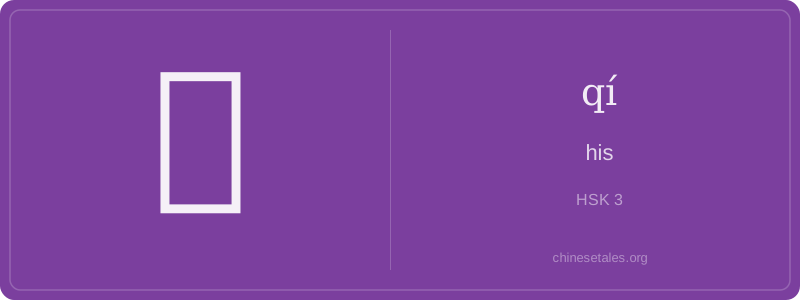
The earliest form of 其 appears in bronze inscriptions as a pictograph resembling a winnowing basket — a shallow, open container with handles, used to separate grain from chaff. It was drawn with curved sides and two symmetrical ‘handles’ on top, later stylized into the modern upper component (⺼) and lower 八-like base. Over centuries, the basket shape simplified: the rim became the top horizontal stroke, the handles morphed into the two diagonal strokes, and the base evolved into the radical 八 — not because it means ‘eight’, but because the basket’s splayed legs looked like diverging lines, echoing the shape of 八.
This humble basket gave rise to a surprisingly abstract meaning: ‘that which is contained or selected’. In early texts like the *Book of Documents*, 其 began marking referents — ‘the grain thus separated’, then ‘the matter under discussion’, then simply ‘that one’ or ‘its’. Confucius used it constantly in the *Analects* to point back to virtues, principles, or people already named — e.g., ‘Jūn zǐ wú suǒ zhēng… qí shè yě, jūn zǐ zhī shè yě’ (The gentleman does not compete… yet in archery, it is the gentleman’s archery). Its visual openness — like an empty basket ready to hold meaning — perfectly mirrors its grammatical role: a placeholder waiting to be filled by context.
Imagine you’re reading a Chinese detective novel: the sleuth points at a suspect and says, ‘Look at qí expression!’ — not ‘his’ in the possessive sense, but ‘that one’s’, ‘the aforementioned’, ‘the very one we just discussed’. That’s the real flavor of 其: it’s not a casual ‘his’ like English — it’s formal, literary, and deeply contextual. It rarely stands alone; instead, it glues ideas together like linguistic Velcro, anchoring pronouns, demonstratives, or even abstract concepts to what came before.
Grammatically, 其 is a third-person determiner or pronoun — think ‘its’, ‘their’, ‘that’, or ‘such’ — but only in written or formal spoken contexts (news, essays, idioms). You’ll never hear it in ‘Wǒ yào qí de shū’ (I want his book); that’s wrong. Instead, it appears in patterns like 其实 (qí shí, ‘actually’) or 其中 (qí zhōng, ‘among them’). In classical texts, it often means ‘his/her/its’ *only* when the possessor is clearly established earlier — like ‘Zǐyuǎn yǒu sān gè dìzi. Qí zhǎngzhě shàn shūfǎ.’ (Master Ziyuan has three disciples. The eldest among them excels at calligraphy.)
Culturally, 其 is a quiet gatekeeper: its presence signals formality, precision, and respect for textual coherence. Learners often overuse it trying to sound ‘more Chinese’, but native speakers avoid it in speech unless quoting proverbs or giving speeches. A classic mistake? Substituting 其 for 他/她/它 — which instantly makes your sentence sound archaic or stiff. Remember: 其 doesn’t own things — it *references* them elegantly, like a scholar nodding toward a previously mentioned idea without repeating it.