冒
Character Story & Explanation
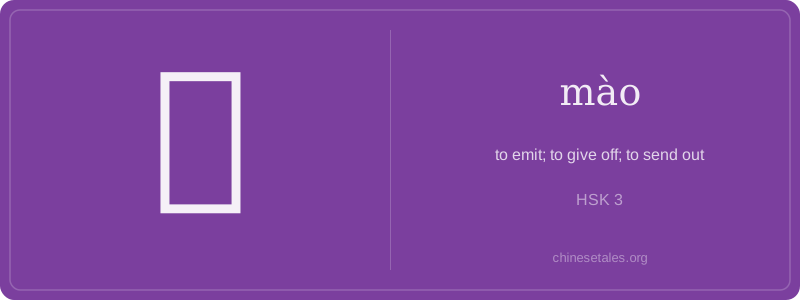
The earliest form of 冒 in oracle bone script looked like a stylized head with two horizontal lines above — representing steam or vapor rising from a person’s crown! Over time, this evolved: the top became the two dots (冂’s upper strokes), the middle simplified into the ‘eye’-like component (not actually 目, but a vestigial head shape), and the bottom became the ‘clothing’ radical 冂 — originally depicting a person wearing a robe, now just a frame. By the seal script era, the structure solidified into today’s 9-stroke form: two dots on top (vapor), then a ‘lid’ (冂), and below — wait, no ‘bottom’ stroke! That’s key: the open space beneath symbolizes vapor escaping upward, uncontained.
This visual logic shaped its meaning: from 'vapor rising from the head' → 'to emit, send out' → 'to emerge boldly'. In classical texts like the Shuōwén Jiězì, 冒 is defined as 'the appearance of vapor above the head', and Confucian commentators noted how it implied 'acting before full preparation' — hence its extension to 'rash action' (冒进) or 'impersonation' (冒名), where someone 'rises up' falsely, like vapor without source. Even today, the character’s open-bottomed frame whispers: nothing’s holding this back — it’s coming out, now.
Think of 冒 (mào) as Chinese’s version of a steam kettle whistling — not just 'emitting' vapor, but doing it with visible energy, intention, and often a hint of urgency. Unlike English verbs like 'emit' or 'give off', which feel clinical or passive, 冒 carries a sense of something breaking *upward* and *outward*: smoke rising from a chimney, steam bursting from a pot, even boldness 'bursting forth' (as in 冒险). It’s rarely neutral — there’s usually motion, visibility, and a slight edge of excess or spontaneity.
Grammatically, 冒 is almost always a verb followed by what’s being emitted — no preposition needed. You say 冒烟 (mào yān, 'emit smoke'), not *mào yān de*. It also appears in compound verbs like 冒出来 (mào chū lái, 'pop out') or 冒着 (mào zhe, 'while emitting/braving', as in 冒着雨 walking in the rain). A classic learner mistake? Using 冒 for abstract 'giving off' like 'she gives off confidence' — that’s more 有气场 or 散发; 冒 demands physical, observable emission.
Culturally, 冒 has a double life: it’s both literal (steam, smoke, bubbles) and metaphorical (risk, audacity), which explains why 冒险 (mào xiǎn, 'to risk') feels so visceral — you’re not just 'taking' a risk, you’re *emitting* or *bursting into* danger. Learners often overuse it because it sounds strong and active, but native speakers reserve it for moments where something visibly, energetically breaks surface — whether it’s vapor from a hot cup or a rash decision from an impulsive friend.