向
Character Story & Explanation
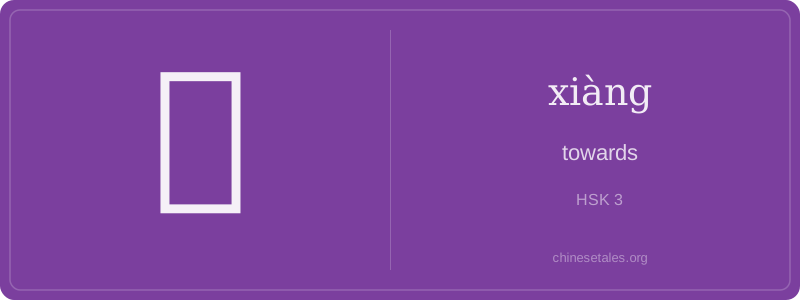
The earliest form of 向 appears in oracle bone inscriptions as a stylized house with an open window or doorway facing outward — a simple pictograph: a square (representing a dwelling) with a line extending from one side, symbolizing the direction one looks or moves *out from home*. Over time, the roof and walls simplified into the top 口 (kǒu, 'mouth' or 'opening') radical, while the lower part evolved from a directional stroke into the now-familiar 匕 (bǐ, an ancient variant of 'spoon' or 'dagger-axe', here implying 'pointing' or 'directing'). By the seal script era, it had crystallized into the modern six-stroke form — a mouth-shaped opening pointing decisively rightward.
This visual logic held firm through history: in the Shījīng (Book of Songs), 向 appears in lines like '君子所向,小人所望' ('Where the noble man turns, the petty man gazes'), preserving its core sense of intentional orientation. Confucius used 向 in moral contexts too — 向善 (xiàng shàn, 'turn toward goodness') — showing how early the character bridged physical direction and ethical aspiration. Its enduring shape remains a quiet reminder: even a simple doorway can point you toward virtue.
At its heart, 向 (xiàng) is about direction — not just physical 'towards' a place, but also metaphorical movement: towards a goal, towards a person, towards an idea. It’s not static; it implies intention and trajectory, like an arrow finding its target. Think of it as the Chinese equivalent of English prepositions 'toward(s)', 'to', or 'in the direction of' — but with more grammatical muscle.
Grammatically, 向 is a versatile preposition that *always* introduces the target of an action — never the subject or verb. You’ll see it before nouns or pronouns: 向老师提问 (xiàng lǎoshī tíwèn, 'ask a question to the teacher'), not *向提问老师*. Crucially, it’s not interchangeable with 对 (duì), which focuses on 'regarding' or 'in relation to' (e.g., 对这个问题 — 'regarding this issue'). Learners often mistakenly use 向 for 'about' or 'concerning' — a red flag that changes meaning entirely.
Culturally, 向 carries subtle respect: 向长辈鞠躬 (xiàng zhǎngbèi jūgōng, 'bow toward elders') emphasizes orientation and reverence, not just physical angle. Also beware of tone traps: xiàng (4th tone) is easily mispronounced as xiāng (1st tone, 'mutual'), especially in fast speech. And remember — unlike 在…上/里/下, 向 doesn’t indicate location, only direction of motion or attention.