不
Character Story & Explanation
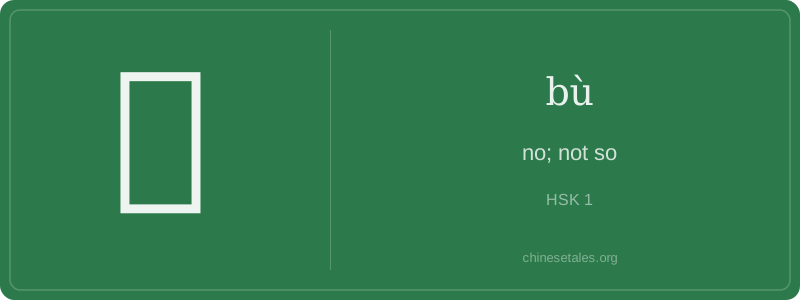
The earliest form of 不 appears in Shang dynasty oracle bone inscriptions as a stylized pictograph resembling a flying bird with outstretched wings — specifically, a type of pheasant called a ‘fū’ (鳺), whose name sounded like *bù*. Over centuries, the bird’s body and tail simplified dramatically: the head became the top horizontal stroke (一), the wings transformed into two left-slanting strokes (丿丿), and the tail evolved into the final right-slanting stroke (丶). By the Qin dynasty’s small seal script, it had shed all avian detail, becoming the clean, angular 四-stroke shape we write today — a perfect example of phonetic loan: borrowing a character’s sound for a new, abstract meaning.
This semantic leap — from ‘pheasant’ to ‘no/not’ — happened because the word *bù* (the bird’s name) was already a common negator in Old Chinese, likely due to phonetic coincidence or ritual taboo avoidance. By the time of the Analects, 不 was fully entrenched as the standard negator, appearing over 200 times — including the famous opening line: ‘学而时习之,不亦说乎?’ (Is it not delightful…?). Visually, its stark, downward-sweeping strokes evoke decisive rejection — like arms pushing away or rain falling *not* upward. Even today, its shape feels like a visual ‘stop sign’ — simple, immediate, and impossible to ignore.
At first glance, 不 looks disarmingly simple — just four strokes, a horizontal line at the top and three descending diagonal strokes. But don’t be fooled: this tiny character is Mandarin’s most indispensable negator, carrying the weight of refusal, denial, and contrast in nearly every conversation. Its core feeling isn’t harsh or angry — it’s firm, clean, and quietly absolute, like flipping a light switch off. Unlike English ‘not’, which often clings to verbs (‘do not go’), 不 stands independently before verbs, adjectives, and even other adverbs — always refusing politely but unambiguously.
Grammatically, 不 is the workhorse of negation for present/future actions and states: 我不饿 (wǒ bù è, 'I’m not hungry'), 他不去 (tā bù qù, 'He won’t go'). Crucially, it *never* pairs with the past-tense particle 了 — that’s where 没 (méi) takes over (e.g., 没去, not *不去了*). Learners often overgeneralize 不 into past contexts or misplace it after verbs — a classic error that makes sentences sound jarringly unnatural. Also, watch tone sandhi: before fourth-tone syllables, 不 changes to bú (e.g., bú hǎo), a subtle but essential shift.
Culturally, 不 carries quiet power — think of the Confucian ideal of ‘knowing when to say no’ (知止). It appears in foundational phrases like 不知道 (bù zhī dào, 'I don’t know') — often used as a polite hedge, not just ignorance. And while English might soften refusal with ‘maybe’ or ‘I’ll try’, Chinese frequently opts for clear, respectful 不 — a linguistic reflection of valuing directness within harmony.