坏
Character Story & Explanation
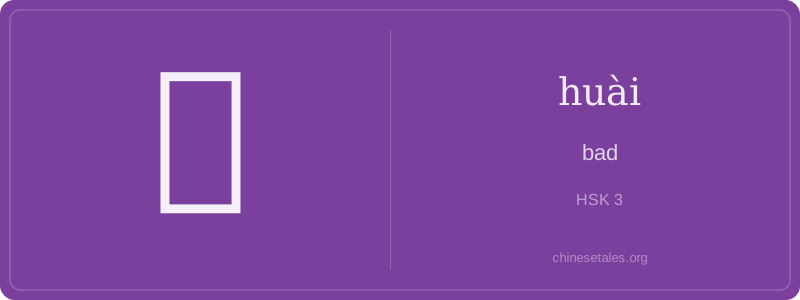
The earliest form of 坏 appears in bronze inscriptions around 1000 BCE as a compound: on the left, 土 (tǔ, 'earth/soil'), and on the right, 㠯 (yǐ, an ancient variant of 已, meaning 'to stop' or 'to complete'). But here’s the twist — that right side evolved into 怀 (huái, 'to hold in the bosom'), then simplified to the modern 右 (right) component. Visually, it’s 土 + 不 (bù, 'not') — though historically, the right side wasn’t 不 but a phonetic loan. The seven strokes now clearly split: the earth radical grounds it, while the jagged upper-right shape (like a collapsed roof) hints at decay or failure.
By the Han dynasty, 坏 meant 'to ruin' or 'to spoil' — appearing in texts like the *Shuōwén Jiězì* (100 CE) as 'to damage what is whole'. Its core idea wasn’t moral corruption but *structural breakdown*: soil eroding, walls crumbling, plans falling apart. Confucius never used 坏 to condemn character; he reserved words like 惡 (è, 'hateful') for ethics. Instead, 坏 stayed practical — describing tangible deterioration. That ancient link between 'earth' and 'decay' still echoes: think of soil washing away (shuǐ tǔ liú shī) or foundations rotting — all rooted in the same visual logic.
At first glance, 坏 (huài) means 'bad' — but in Chinese, it’s rarely moralistic or absolute like English 'evil'. Instead, it’s deeply pragmatic: something is 坏 when it’s *functionally broken* (a phone, a plan, a tooth) or *socially disruptive* (a 'bad' kid isn’t wicked — they’re disobedient or noisy). This reflects a worldview where value is tied to utility and harmony, not abstract virtue. You’ll hear 坏 used for spoiled milk (mǐlì huài le), a ruined surprise (jīngxǐ huài le), or even affectionate teasing ('You little rascal!' — nǐ zhège huài dàn!).
Grammatically, 坏 is almost always an adjective — but unlike English, it rarely stands alone before a noun. You won’t say *huài rén* for 'a bad person'; instead, you’d use èrén (evil person) or more naturally, bù hǎo de rén. Instead, 坏 shines after verbs: huài le (‘broke’), huài shì (‘screwed up’), or as part of set phrases like huài xiào (‘to laugh uncontrollably’ — literally ‘laugh-bad’!). Learners often overuse it like English 'bad', missing subtler alternatives like chā (poor), cì (inferior), or wú yòng (useless).
Culturally, calling something 坏 carries gentle resignation — not anger. A parent sighing 'diàn huà huài le' ('the phone’s broken') sounds weary, not furious. And watch out: in internet slang, huài can flip ironically — 'zhè ge rén tài huài le!' might mean 'This person is *so* delightfully mischievous!', especially among teens. That playful reversal? Pure Chinese linguistic wit.