居
Character Story & Explanation
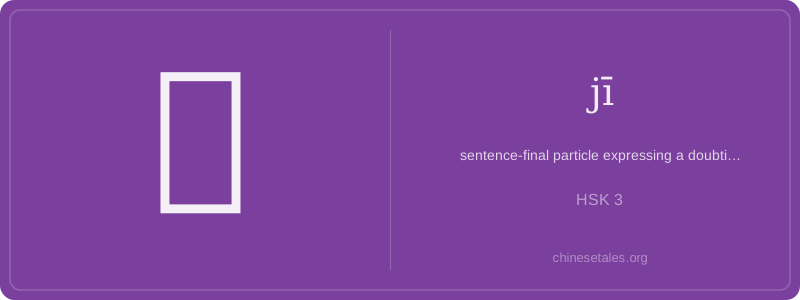
The earliest form of 居 (in oracle bone script) showed a person (人) standing beside a shelter or doorway (尸 + 尸-like enclosure), later standardized in bronze inscriptions as a person under a roof — clearly depicting ‘dwelling’ or ‘residing’. Over centuries, the top simplified into the radical 户 (hù, ‘door’ or ‘household’), while the bottom evolved from a kneeling figure into the modern 古 (gǔ, ‘ancient’) — not because it means ‘ancient’, but due to phonetic borrowing and clerical script streamlining. The eight strokes now neatly balance door (户, 4 strokes) and ancient (古, 5 strokes — but note: the overlapping stroke at the junction reduces total count to 8).
This visual logic — ‘door’ + ‘ancient’ — subtly reinforced its semantic shift: from concrete ‘to dwell’ (jū) to abstract ‘to pause in thought’ (jī). In the Zuo Zhuan and Mencius, 居 appears in phrases like ‘jū rán ér tàn’ (suddenly pausing to sigh), where the ‘dwelling’ sense metaphorically extends to mental stillness. That lingering quality — dwelling in uncertainty — eventually crystallized into the doubting particle jī, preserving the character’s original essence: not movement, but thoughtful suspension at the threshold of knowledge.
Don’t let the simple shape of 居 fool you — in its jī pronunciation, it’s a linguistic whisper, not a shout. As a sentence-final particle (rare but charmingly archaic), it softens statements into gentle, almost rhetorical doubts: ‘Could it be…?’, ‘I wonder if…’ — like raising an eyebrow mid-sentence. It carries the quiet skepticism of a Confucian scholar pausing before committing to certainty. You’ll rarely hear it in daily speech today, but it appears in literary texts, idioms, and formal writing to evoke elegance, hesitation, or polite irony.
Grammatically, 居 (jī) only appears at the very end of a clause or sentence — never mid-sentence, never attached to verbs. Think of it as punctuation with personality: ‘Tā shì lǎoshī jū?’ (He’s a teacher… or is he?) — that final jī doesn’t ask for confirmation; it invites shared reflection. Learners often misplace it (e.g., *tā jū shì lǎoshī) or confuse it with the much more common interrogative 吗 — but 吗 demands an answer, while 居 suspends the question in the air, like incense smoke.
Culturally, this particle reveals a deep Chinese value: intellectual humility. Rather than asserting truth outright, 居 lets speakers hedge with grace — aligning with classical ideals of ‘knowing what you don’t know’ (《论语》: 知之为知之,不知为不知). Modern learners overuse it trying to sound ‘literary’, but native speakers reserve it for poetic, ironic, or gently skeptical moments — like adding a semicolon instead of a period. Its rarity makes it precious: wield it sparingly, and it lands like a haiku.