水
Character Story & Explanation
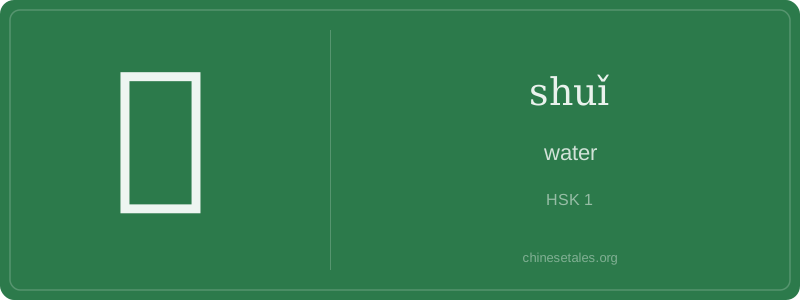
Picture this: over 3,000 years ago, Shāng dynasty scribes carved 水 into oracle bones not as lines, but as a vivid pictograph — three wavy horizontal lines flowing left to right, with a central vertical stroke anchoring the current. That original glyph looked like water cascading down a slope! As writing moved to bronze inscriptions, the waves simplified into two angled strokes flanking a dot, and the lower curve emerged to suggest depth and motion. By the seal script era, the shape had rotated 90 degrees clockwise — transforming from a landscape view into the upright, dynamic form we know today: the dot (a droplet), two slanting ‘ripples’, and the sweeping hook (the river’s bend).
This visual logic stayed alive through millennia: Confucius praised water’s moral clarity (‘It benefits all things without contention’), and in classical poetry, 水 is never just H₂O — it’s time passing (‘flowing water never returns’), emotion unspoken (tears as ‘sorrow-water’), or even danger (‘waters rise’ = crisis looms). Even today, when Chinese people sketch 水 casually, they instinctively draw the dot first — as if capturing the very moment a drop falls — honoring its ancient, liquid soul.
At its heart, 水 (shuǐ) isn’t just ‘water’ — it’s the primordial flow of life itself in Chinese thought. Unlike English, where ‘water’ is a neutral noun, 水 carries philosophical weight: it’s one of the Five Elements (wǔ xíng), symbolizing adaptability, wisdom, and quiet power (think: ‘The highest good is like water’ — Lǎozǐ). Visually, it’s deceptively simple — just four strokes — but every line echoes movement: the central ‘dot’ suggests a droplet, the two diagonal strokes mimic ripples spreading outward, and the final hook traces the curve of a streambed.
Grammatically, 水 is refreshingly straightforward at HSK 1: it’s a concrete noun that rarely changes form. You’ll use it with measure words like 一 杯 (yī bēi, 'a cup of') or 一 瓶 (yī píng, 'a bottle of'), never *shuǐ* alone as an adjective — that’s a classic mistake! Learners sometimes try to say *shuǐ hěn lěng* ('water very cold') without the subject marker or verb; instead, you need 我 喝 水 (wǒ hē shuǐ, 'I drink water') or 这 是 水 (zhè shì shuǐ, 'This is water'). It almost never stands alone as a sentence — context is king.
Culturally, 水 appears everywhere — from the idiom 水 到 渠 成 (shuǐ dào qú chéng, 'when water reaches the channel, success follows' = things fall into place naturally) to taboo phrases like 喝 水 (hē shuǐ, literally 'drink water', but slang for 'being silenced' in political contexts). Also, beware tone: shuǐ (third tone) sounds nothing like shuí (who) or shù (number four) — mispronouncing it can turn your order for water into a question about identity!