惯
Character Story & Explanation
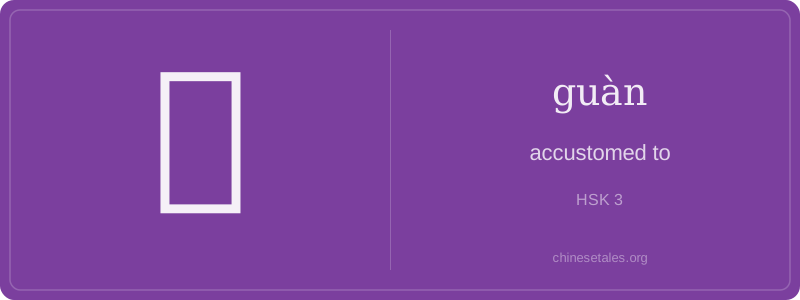
The earliest form of 惯 appears in seal script as a combination of 忄 (heart/mind radical) and 贯 (guàn, ‘to thread through’ — originally a pictograph of a string passing through shells or coins). The ‘threading’ idea wasn’t literal sewing — it was metaphorical: actions repeated so often they become *strung together*, forming an unbroken mental pathway. Over centuries, the right side simplified from the full 貫 (with 貝 ‘shell-money’) to today’s 贯, while the left retained 忄 — signaling this isn’t physical routine, but internalized, emotionally resonant patterning.
This threading metaphor became philosophical gold. In the Xunzi, the Warring States thinker writes, ‘积善成德,而神明自得,圣心备焉’ — virtue accumulates like threads, and wisdom emerges naturally. 惯 embodies that accumulation: not sudden insight, but slow, steady weaving of experience into instinct. Its presence in classical texts always hints at transformation through repetition — whether mastering ritual (li) or falling into vice. Visually, those 11 strokes feel like a tight knot: the three dots of 忄 pulse gently, then the flowing strokes of 贯 wrap around them like habit itself — persistent, binding, and hard to undo.
At its heart, 惯 (guàn) isn’t just about ‘being used to’ something — it’s about the quiet, almost invisible weight of repetition shaping identity. In Chinese thinking, habit isn’t neutral; it’s a force that molds behavior, expectations, and even moral character. That’s why you’ll hear phrases like ‘习惯成自然’ (xí guàn chéng zì rán) — ‘habit becomes second nature’ — reflecting a deep cultural belief: who you are is shaped by what you repeatedly do, not just what you intend.
Grammatically, 惯 almost never stands alone. It lives inside compounds like 习惯 (xí guàn) or as part of the verb phrase 惯着 (guàn zhe), meaning ‘to spoil’ — literally ‘to let someone get accustomed to indulgence’. Learners often mistakenly use 惯 as a standalone verb like ‘I am accustomed’, but in natural speech, you’d say 我习惯了 (wǒ xí guàn le) — using the full compound 习惯 as the verb, with 惯 as its inseparable, rhythmic second half.
Culturally, 惯 carries subtle judgment: 惯坏 (guàn huài) means ‘to spoil rotten’, implying moral consequence — a child over-indulged isn’t just pampered, they’re *damaged by habit*. A common error is confusing 惯 with 熟 (shú, ‘familiar’) — but while 熟 is about knowledge or skill, 惯 is about behavioral conditioning, often with emotional or social baggage attached.