戏
Character Story & Explanation
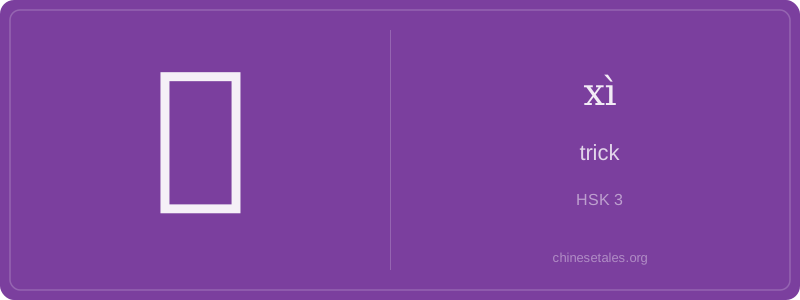
The earliest form of 戏 appears in bronze inscriptions around 1000 BCE—not as a ‘play’ but as a weapon dance. The top part (虛) was originally a stylized ‘mask’ or ‘spirit face’, while the bottom radical 戈 (gē, halberd) showed warriors brandishing weapons in ritual combat. Over centuries, the mask simplified into the modern 虚 component (XU, meaning ‘empty’ or ‘illusory’), and the 戈 remained—anchoring the idea that performance began as sacred, armed mimicry. By the Han dynasty, scribes streamlined it to six strokes: two horizontal lines (top of 虚), then the ‘X’ shape (middle of 虚), and finally the 戈 with its signature dot and slanted stroke.
This visual fusion—‘empty/illusory’ + ‘weapon’—perfectly captures how early Chinese theatre worked: ritual reenactments where warriors *pretended* to fight, transforming real violence into symbolic, safe spectacle. Confucius himself praised ‘proper music and dance’ (yǎ yuè) as moral education—so 戏 wasn’t frivolous entertainment but ethical training through controlled illusion. Even today, when someone says ‘Zhè bú shì xì ma?’ (Isn’t this just a show?), they’re invoking that ancient layer: performance as intentional, meaningful unreality.
Imagine you’re at a Beijing hutong teahouse, and an old man suddenly pulls a coin from behind your ear—then winks and says, 'Zhè shì yī chǎng xì!' (This is a trick!). That’s 戏 in action: not just ‘trick’ as in deception, but the playful, performative magic of illusion, role-play, or lighthearted deceit. In Chinese, 戏 carries warmth and theatricality—it’s rarely sinister. It’s the wink before the punchline, the feint in martial arts, the charming fib a parent tells a child ('The moon followed us home!').
Grammatically, 戏 often appears in set phrases like kāi wán xiào (to joke) or xì nòng (to tease playfully), but it also functions as a noun meaning ‘drama’ or ‘opera’—yes, the same character! That’s why you’ll see it in jīngjù (Peking opera) or xì jù (play). Learners sometimes overgeneralize it to mean any kind of ‘trick’ (like a magic trick *or* a scam), but 戏 implies artistry and consent—it’s never malicious fraud (that’s zhà or piàn).
Culturally, this duality—‘trick’ and ‘theatre’—isn’t accidental. Ancient Chinese ritual performances involved masked dancers mimicking spirits or heroes: illusion *was* worship. Today, saying ‘Tā zài xì nòng nǐ’ (He’s teasing you) sounds affectionate, not hostile—unlike English ‘trick’, which can carry suspicion. A common mistake? Using 戏 alone as a verb (e.g., *wǒ xì nǐ*). Nope—it needs a partner word: xì nòng, kāi xì, or wán xì. Think of it as a social dance, not a solo move.