扫
Character Story & Explanation
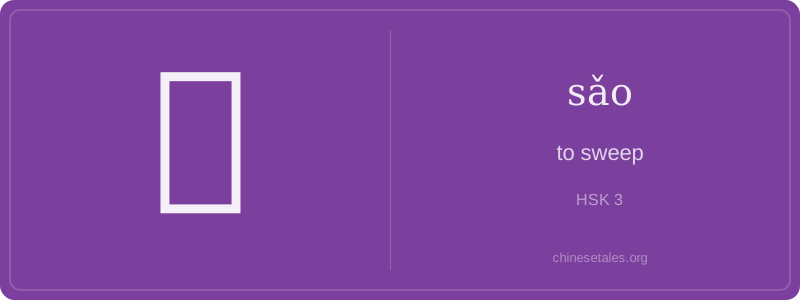
The earliest form of 扫 appears in bronze inscriptions as a hand (又) holding a broom-like tool with bristles — often drawn as three parallel strokes fanning outward. Over time, the hand evolved into the modern 扌 radical (hand-action indicator), while the broom simplified into 彐 — originally depicting the broom’s handle and bristles, later stylized beyond recognition. By the Han dynasty, the six-stroke structure we know today was standardized: 扌 + 彐 — literally 'hand + broom shape', a perfect semantic-phonetic blend (though 彐 here is now purely symbolic, not phonetic).
This character’s meaning stayed remarkably consistent: from Shuōwén Jiězì (121 CE), which defined 扫 as 'to remove with a broom', to Tang poetry where Du Fu wrote of 'sweeping fallen leaves' (扫落叶), the core idea of *removal by sweeping motion* never wavered. Interestingly, its visual simplicity — just six strokes — mirrors its functional elegance: no flourish, no ambiguity, just action. Even today, when you scan a QR code with your phone, you’re digitally reenacting that ancient gesture — hand moving across surface, clearing one layer to reveal what lies beneath.
Imagine your Chinese host mom standing in her tidy courtyard at dawn, holding a bamboo broom — not just sweeping dust, but *sǎo*ing away last night’s lingering chaos. That’s the feel of 扫: active, rhythmic, purposeful clearing — whether of floors, data, or even unwanted guests. It’s never passive; it always implies deliberate motion and completion. You’ll hear it in daily life: 扫地 (sǎo dì, 'to sweep the floor'), 扫码 (sǎo mǎ, 'to scan a QR code'), and even 扫黄 (sǎo huáng, 'to crack down on pornography') — yes, this humble 'sweep' verb powers China’s digital and regulatory infrastructure!
Grammatically, 扫 is a transitive verb that usually takes a direct object (e.g., 扫地, 扫雪). It can also appear in resultative complements like 扫干净 (sǎo gānjìng, 'to sweep clean'). Learners often mistakenly use it where English says 'clean' broadly — but 扫 specifically means *horizontal, sweeping motion*, not wiping or scrubbing. Don’t say 扫桌子 for 'wipe the table'; use 擦 (cā) instead. Also, avoid overusing 扫 as a generic 'clean' — it’s precise, not poetic.
Culturally, 扫 carries subtle weight: during Spring Festival, families must 扫尘 (sǎo chén, 'sweep dust') before New Year’s Eve — symbolically removing bad luck. And while sǎo is standard, the alternate reading sào appears only in rare dialectal or fossilized terms like 扫帚 (sào zhou, 'broom'), where the second syllable preserves an older pronunciation. Don’t worry — for HSK 3, stick with sǎo!