故
Character Story & Explanation
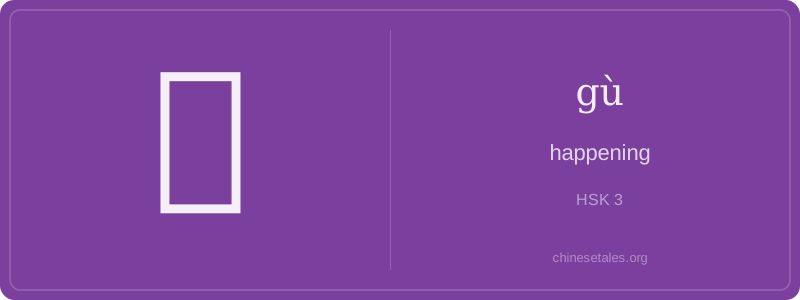
The earliest form of 故 appears in bronze inscriptions around 1000 BCE: a combination of 古 (gǔ, ‘ancient’) on the left — drawn as a mouth (口) atop ten (十), symbolizing ‘long ago, spoken of many times’ — and 攴 (pū), a hand holding a stick (later simplified to 攵), representing ‘to strike’ or ‘to act’. So visually, it was ‘ancient action’ — something done long ago that still echoes today. Over centuries, 古 softened into its modern shape (十 + 口), and 攴 evolved into the ‘walk-stick’ radical 攵 (‘to act upon’), giving us today’s clean, balanced 9-stroke character.
This visual duality — ancient + action — birthed its core semantic field: cause, reason, and consequence. In the *Zuo Zhuan* (c. 4th c. BCE), 故 appears constantly to introduce causal explanations: ‘Zheng Bo attacked Song because… 故…’. By Han dynasty texts, it also meant ‘former’ (as in 故国 — ‘former state’), linking identity to ancestral origin. The stroke count — 9 — subtly reinforces its weight: in Chinese cosmology, nine is the highest yang number, symbolizing completeness and enduring influence — fitting for a character that binds past to present.
At its heart, 故 isn’t just ‘happening’ — it’s the quiet gravity of *what has already taken place*, the invisible thread connecting past action to present consequence. Think of it as ‘therefore’, ‘hence’, or ‘for this reason’ — not a random event, but a logical, often inevitable, outcome rooted in what came before. Its tone is formal, literary, and slightly solemn: you’ll rarely hear it in casual chat, but it’s everywhere in written Chinese, news headlines, and classical idioms.
Grammatically, 故 most often appears as a conjunction meaning ‘therefore’ or ‘thus’, usually at the start of a clause (e.g., 他很累,故提前回家). It can also function as a noun meaning ‘reason’ or ‘cause’ (as in 无故缺席 — ‘absent without cause’), or even as an adjective meaning ‘former’ or ‘old’ (故友 — ‘old friend’). Learners often mistakenly treat it like the more colloquial 所以 — but 故 is denser, more compact, and carries subtle weight; overusing it sounds stiff or archaic, while underusing it misses nuance in formal texts.
Culturally, 故 embodies the Chinese worldview where cause-and-effect isn’t just logic — it’s moral and historical continuity. Confucius used it to link virtue with consequence (《论语》: ‘君子有九思…事思敬,疑思问,忿思难,见得思义’ — implicit 故 underlies each ‘therefore’). A common pitfall? Pronouncing it as ‘gū’ (like 谷) instead of ‘gù’ — that tiny falling tone signals finality, not openness. Also, don’t confuse its ‘therefore’ with ‘but’ — it never introduces contrast, only consequence.