李
Character Story & Explanation
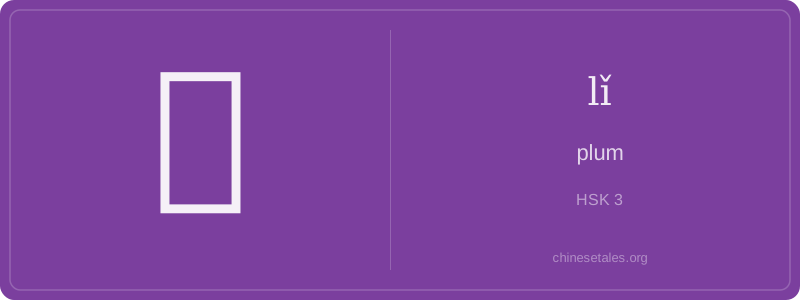
The earliest form of 李 appears in bronze inscriptions around 1000 BCE — a simple pictograph showing a tree (木) with three small circles hanging from its branches, representing plums. Over centuries, the circles stylized into three short horizontal strokes above the 木 radical, while the trunk and roots simplified into the clean, balanced structure we know today: a 7-stroke character with wood (木) at the bottom anchoring the fruit overhead. By the Warring States period, the three dots had fused into the top component — now called 子 (zǐ), though here it’s purely phonetic and no longer means 'child'.
This visual logic held firm: wood + fruit = plum tree. In the *Classic of Poetry* (*Shījīng*), 李 appears in odes praising orchards and seasonal cycles — 'Peaches and plums, flourishing and fair' — linking it early to beauty and natural order. The character’s stability across 3,000 years is remarkable: unlike many characters that shifted meaning or merged forms, 李 kept its core identity — botanically precise, culturally resonant, and visually unmistakable. Even today, seeing those three dots above 木 instantly evokes clusters of ripe, purple-red fruit against dark bark.
Imagine walking through a spring orchard in Suzhou, where delicate pink plum blossoms drift down like snow — and an elderly gardener points to a tree, saying 'Zhè shì lǐ shù' (This is a plum tree). That’s 李 in action: not just a fruit, but a symbol of resilience (blooming in winter cold) and elegance. In modern Mandarin, 李 almost never stands alone as 'plum' — you’ll see it in compounds like 李子 (lǐ zi, 'plum fruit') or 李树 (lǐ shù, 'plum tree'). It’s rare to say *just* '李' meaning 'plum' outside poetic or classical contexts.
Grammatically, 李 is most famous for being China’s second-most-common surname — over 100 million people bear it! So when you hear 'Lǐ Xiǎomíng', that’s not 'Plum Xiaoming' — it’s the name Li Xiaoming. Learners often mistakenly treat 李 as a standalone noun for 'plum' in speech ('Wǒ chī le yī gè lǐ'), but native speakers almost always say 李子. Using 李 alone sounds archaic or overly literary — like saying 'apple' instead of 'an apple' in English without context.
Culturally, 李 carries quiet prestige: Lǐ Bái (Li Bai), the immortal Tang poet, bore this surname — and the character itself appears in the ancient text *Shuōwén Jiězì* as 'a fruit tree with sweet, edible fruit'. A common mistake? Confusing it with 理 (lǐ, 'reason') or 里 (lǐ, 'mile/neighborhood') — same sound, wildly different meanings. Remember: 李 grows on trees; 理 lives in your head; 里 measures distance or community.