净
Character Story & Explanation
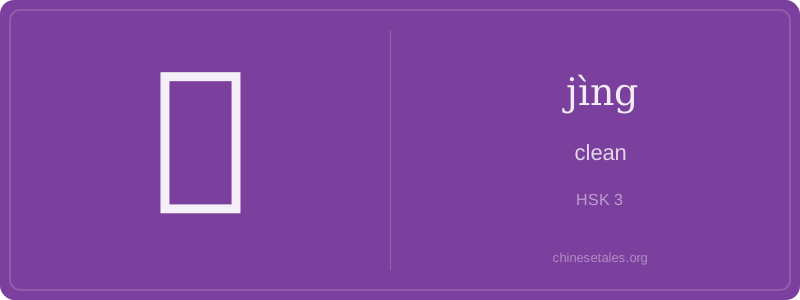
The earliest form of 净 appears in seal script as a combination of 冫 (bīng, ‘ice’ — representing cold purity) and 争 (zhēng, ‘to vie’ or ‘strive’), but crucially, the top part evolved from a pictograph of a hand holding a tool to *remove impurities* — imagine scraping frost off glass. Over time, 争 simplified visually (losing its ‘hand’ component) and merged with 冫 into today’s compact 8-stroke form: two icy dots on top, then a streamlined ‘争’ below — the whole character whispering ‘cold clarity achieved through effort’.
This visual logic shaped its semantic journey: from early texts like the *Shuōwén Jiězì* (121 CE), 净 meant ‘water so clear you can see the bottom’, then broadened to moral purity (e.g., Buddhist sutras praising a ‘净心’ — ‘pure mind’), and later to mathematical precision (‘净得五分’ — ‘net gain of five points’). Its ice radical wasn’t arbitrary — in ancient China, ice symbolized both stillness and rigorous self-discipline. Even today, when we say 一尘不染 (‘not a speck of dust’), the ‘dust’ evokes mental clutter, and 净 is the quiet, crystalline opposite.
At its heart, 净 (jìng) isn’t just about physical cleanliness — it’s about *clarity*, *purity of state*, and even *moral or spiritual unclutteredness*. Unlike English ‘clean’, which often focuses on absence of dirt, 净 implies a satisfying, almost serene completeness: water that’s perfectly clear, a mind free of distraction, or a task stripped down to its essential truth. You’ll hear it in phrases like ‘净重’ (net weight) — not just ‘what’s left’, but ‘what truly counts, with all non-essentials removed’.
Grammatically, 净 is unusually flexible for an adjective: it can stand alone after 很 or 太 (e.g., 很净), but more distinctively, it functions as an adverb meaning ‘entirely’ or ‘only’ — especially before verbs (e.g., 他净吃肉 = ‘He *only* eats meat’). This adverbial use trips up learners because it looks like an adjective but behaves like a quantifier. Also, note it’s rarely used predicatively without a modifier — you wouldn’t say *‘这房间净’; you’d say *‘这房间很净’* or *‘这房间干干净净’*.
Culturally, 净 reflects the Chinese value of *jian* (simplicity) and *qing* (clarity) — think of ink-wash painting where empty space is as meaningful as the brushstroke. Learners often overuse it like ‘clean’ in English (e.g., *‘clean the table’ → *‘净桌子’), but the verb for ‘to clean’ is 打扫 or 擦. 净 doesn’t mean ‘to make clean’ — it describes the *resulting state*. Bonus quirk: in Beijing dialect and modern slang, 净 + verb can carry gentle sarcasm — ‘你净瞎说!’ (‘All you do is talk nonsense!’) — implying repetition *and* futility.