渴
Character Story & Explanation
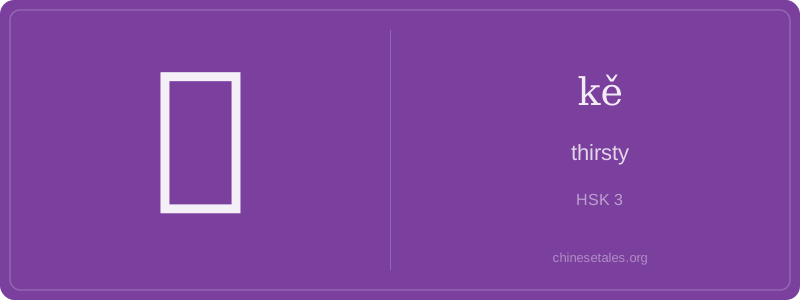
The earliest form of 渴 (in bronze inscriptions, c. 1000 BCE) was a vivid pictograph: a kneeling person (the top part, later simplified to ) beside water (氵), with a curved line suggesting a dry, constricted throat — literally ‘a person with water nearby but unable to drink’. Over centuries, the kneeling figure evolved into the modern 可 (kě) component, while the water radical 氵 stayed firmly on the left, anchoring the meaning in fluidity — or rather, its absence. By the Han dynasty, the character had stabilized into its current 12-stroke form, where 可 acts both as sound clue (kě) and visual echo of ‘capability’ — ironically underscoring the *lack* of capability to quench.
This tension between presence and absence shaped its semantic journey: in the Shuō Wén Jiě Zì (121 CE), Xu Shen defined it as ‘dry mouth, desire for drink’, cementing its physiological core. Yet even then, poets like Du Fu used it metaphorically — ‘my heart is thirsty for justice’ — showing how early Chinese linked bodily sensation to moral urgency. The water radical doesn’t mean ‘water is present’; it signals the *domain* of imbalance — just as fire radical (火) marks heat-related words, 氵 here marks *fluid deficiency*. That’s why 渴 feels so urgent: it’s water’s shadow.
At its heart, 渴 (kě) isn’t just ‘thirsty’ — it’s the visceral, urgent *pull* of dryness: your mouth tightens, your tongue sticks, your throat feels like parchment. In Chinese, it’s almost always an adjective (e.g., 我渴了), but unlike English, it rarely stands alone as a noun (‘a thirst’) — you’d say 口渴 (kǒu kě, ‘mouth-thirst’) for that concept. Crucially, it’s not used for metaphorical thirsts without modification: you wouldn’t say *我渴知识* — instead, you’d use 渴望 (kě wàng, ‘to yearn’). That’s the first big trap!
Grammatically, it behaves like other stative adjectives: it takes 了 to mark change of state (他渴了 — ‘He’s become thirsty’), and can be modified by 很 (hěn), 真 (zhēn), or 特别 (tèbié), but never by 很多 or 非常 in casual speech — that’s overkill. Also, it’s almost never used predicatively without a subject + verb context; saying just ‘渴!’ sounds abrupt, like yelling ‘Thirsty!’ mid-sentence — fine in exclamations with tone (‘渴死了!’), but rare otherwise.
Culturally, 渴 carries subtle weight: in classical texts, it often appears in moral metaphors — Confucius spoke of ‘thirsting for virtue’ (渴慕仁德), linking physical dryness to spiritual longing. Modern learners sometimes overuse it for ‘I want X’, confusing it with 想 (xiǎng) or 希望 (xīwàng). Remember: 渴 is *bodily*, immediate, and sensory — if you’re not actually parched or deeply yearning, reach for another word.