照
Character Story & Explanation
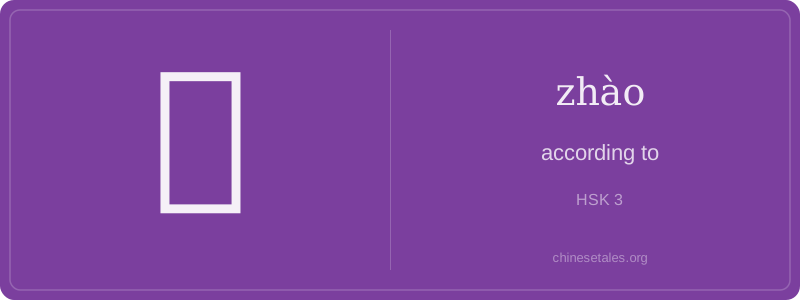
The earliest form of 照 appears in bronze inscriptions (c. 1000 BCE) as a complex pictograph: a person (人) standing beside a sun (日) above a fire (灬), with two eyes (目) added later — suggesting 'a person observing clearly under sunlight and firelight'. Over centuries, the sun and fire merged visually, and the 'person' simplified into the top component ⺌ (a variant of 韶, implying resonance and clarity). By the Han dynasty, the modern shape emerged: ⺌ on top (evoking brightness and order), then 日 (sun), then 灬 (fire) — literally 'sun-fire illumination', reinforcing the idea of revealing truth through light.
This visual logic shaped its semantic evolution: from 'to shine light upon' (as in 照亮, zhàoliàng — 'to illuminate') to 'to reflect/manifest' (as in 照相, zhàoxiàng — 'to photograph', i.e., 'to capture a reflection'), and finally, by the Tang-Song period, to 'to follow as a standard' — because if you 'shine the light of a rule onto your actions', you’re aligning with it. Classical texts like the *Zuo Zhuan* use 照 in phrases like '照章办事' (follow rules scrupulously), cementing its role as the linguistic anchor of principled conduct.
At its heart, 照 (zhào) isn’t just a dry preposition like 'according to' — it’s a verb-turned-adverb that carries the quiet authority of alignment: something is being *brought into light* or *made consistent with* a standard, rule, or model. Think of it as 'shining the light of precedent onto action' — which makes sense, because its radical 灬 (fire) hints at illumination! You’ll often see it in formal instructions, regulations, or polite requests: 照说明书做 (zhào shuōmíngshū zuò) — 'Do it *according to* the manual.' Notice how it always comes *before* the noun it governs, never after — unlike English, where 'according to' can float around.
Grammatically, 照 is almost exclusively used as a preposition meaning 'in accordance with', and it *must* be followed by a noun or noun phrase (e.g., 规定, 计划, 老师的话). It cannot stand alone or take a verb directly — a common error is saying *照做* (which is actually correct as a fixed phrase meaning 'follow instructions'), but learners mistakenly try *照学习* instead of *照计划学习*. Also, avoid confusing it with 按 (àn) — while both mean 'according to', 照 feels more binding, even legalistic; 按 is more flexible and procedural.
Culturally, 照 reflects China’s deep-rooted value of precedent and conformity to shared standards — not blind obedience, but respectful alignment with collective wisdom or documented guidance. You’ll hear it constantly in classrooms, workplaces, and government notices. A subtle trap: in spoken Mandarin, people sometimes drop 照 for brevity (e.g., '按这个来' instead of '照这个来'), but in writing — especially exams — using 照 correctly signals precision and formality.