烧
Character Story & Explanation
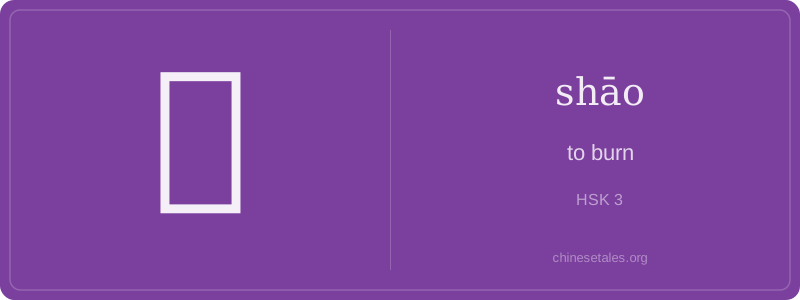
The earliest form of 烧 appears in late Warring States bamboo slips, not oracle bones — but its components are ancient. The left side, 火, was already stylized by then as four dots () representing flames — two low, two high — capturing fire’s restless shape. The right side, 尧, evolved from a bronze script pictograph of a person (亠 + 儿) raising both arms, perhaps dancing near a fire or gesturing command over it. Over centuries, the person’s arms condensed into the top crossbar and slanted strokes of 尧, while the fire radical simplified but kept its vital dot-and-hook rhythm — every stroke feels like a tongue of flame licking upward.
This visual partnership shaped meaning profoundly: fire under human agency. In the Shuōwén Jiězì (121 CE), 烧 is defined as ‘to make fire burn brightly’ — emphasizing intentionality. By the Tang dynasty, poets like Bai Juyi used it vividly: ‘野火烧不尽’ (yě huǒ shāo bù jìn — ‘wildfire burns without end’), where 烧 conveys relentless, active consumption. Even today, the character refuses passivity — you don’t ‘get burned’ (that’s 被烧); you *burn* something, or the fire itself *burns*. Its form is a silent instruction: fire must be directed.
At its heart, 烧 (shāo) is all about *transformation through fire* — not just destruction, but cooking, heating, smelting, even emotional intensity (like ‘burning with anger’). The character pulses with kinetic energy: it’s never passive. Visually, it’s built on the 火 (fire) radical at the left — a dynamic, flickering symbol that always appears in motion — and paired with 尧 (yáo), which originally depicted a person with raised arms, suggesting effort or control over flame. So 烧 isn’t just ‘fire happening’; it’s *intentional ignition*: you light it, stoke it, direct it.
Grammatically, 烧 is wonderfully flexible. As a verb, it takes objects directly (烧水 shāo shuǐ — ‘boil water’) or appears in resultative compounds like 烧坏 (shāo huài — ‘burn out/break by burning’). Crucially, it’s *not* used for spontaneous combustion — if your house catches fire unexpectedly, you’d say 着火 (zháo huǒ), not 烧火. Learners often mistakenly say ‘烧火’ when they mean ‘start a fire’ (correct: 生火 shēng huǒ), or confuse 烧 with 煮 (to boil/stew), which implies longer, gentler heat. Also, note: 烧 can be transitive *or* intransitive — 火烧起来了 (huǒ shāo qǐ lái le) means ‘the fire has broken out’, no object needed.
Culturally, 烧 carries ritual weight: from ancestral offerings (烧纸 shāo zhǐ — burning joss paper) to the fiery passion in idioms like 热情似火 (rèqíng sì huǒ — ‘enthusiasm like fire’). Its HSK 3 status reflects how deeply it’s woven into daily life — whether boiling noodles, charging a phone battery (充电器烧了 chōngdiànqì shāo le — ‘the charger burned out’), or describing a fever: 他发烧了 (tā fā shāo le — literally ‘he emitted fire’, i.e., ‘he has a fever’).