爷
Character Story & Explanation
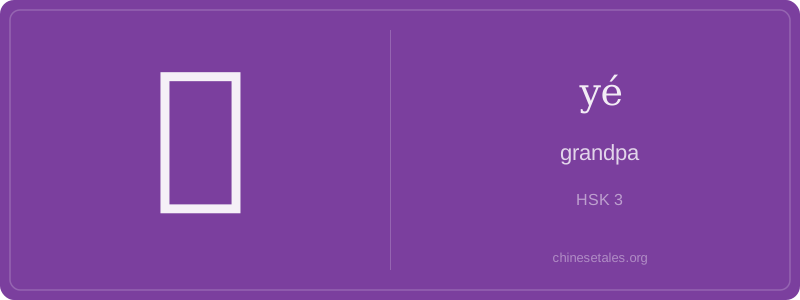
The earliest form of 爷 appears in late Shuōwén Jiězì annotations as a variant of 父 (fù, ‘father’), but its distinct shape emerged during the Song dynasty. Oracle bone and bronze scripts didn’t have 爷 — it’s a later semantic-phonetic compound: top is 父 (fù, ‘father’), the radical anchoring meaning and lineage; bottom is 口 (kǒu, ‘mouth’), added not for sound (since yé isn’t phonetically linked to kǒu), but to suggest vocal presence — the elder who speaks, commands, and blesses. Visually, the six strokes flow downward: two dots (father’s head), a horizontal stroke (shoulders), then the ‘mouth’ box — compact, grounded, unmistakably patriarchal.
This mouth wasn’t about speech alone — in classical usage, it evoked the elder’s ritual role: reciting ancestral names, giving blessings at weddings, or pronouncing judgments in clan matters. By the Ming and Qing dynasties, 爷 expanded beyond kinship: imperial eunuchs addressed princes as ‘Yé’, actors playing generals were called ‘Lóng Tāo Yé’ (Dragon-Robe Lord), and in Beijing opera, ‘Yé’ became shorthand for any commanding male archetype. The character thus fused bloodline, voice, and social weight — turning a simple pictograph into a living vessel of authority and warmth.
Imagine a bustling Beijing hutong in summer — kids chasing dragonflies, elders fanning themselves on stone benches. One grizzled man with spectacles and a faded blue jacket sits sipping tea, calling out 'Xiǎo Míng! Come taste my homemade jujube cake!' — that’s 爷 (yé), not just ‘grandpa’ but a warm, slightly proud, gently authoritative presence. In Chinese, 爷 carries affectionate respect: it’s used for paternal grandfather (爷爷 yéye), but also as an honorific for older men — like a neighborhood elder or even a revered master craftsman (如‘张爷’ Zhāng yé). Crucially, it’s *never* used alone in direct address; you’ll always hear yéye (double form) for ‘grandpa’, or combine it with a surname (Wáng yé).
Grammatically, 爷 appears in fixed kinship terms (爷爷, 爷爷奶奶), never as a standalone noun like ‘grandfather’ in English. Learners often overuse it — saying ‘I saw yé’ instead of ‘I saw yéye’ — or mistakenly attach it to maternal grandfathers (who are 外公 wàigōng, *not* 爷). It also pops up in playful, ironic, or even sarcastic contexts: ‘You think you’re the boss? You’re no yé!’ (你算哪门子爷?Nǐ suàn nǎ ménzi yé?) — where it means ‘big shot’ or ‘self-important person’.
Culturally, 爷 reflects China’s layered respect hierarchy: the 父 radical signals paternal lineage, while the 口 (mouth) hints at vocal authority — the elder who speaks wisdom, settles disputes, tells stories. Unlike formal titles like 先生 (xiānsheng), 爷 feels earthy, intimate, and unpretentious. It’s HSK 3 because it’s frequent in family talk and daily listening — but its emotional texture is what makes it truly alive.