特
Character Story & Explanation
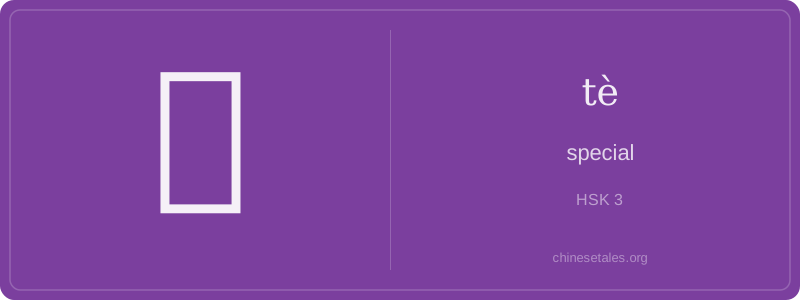
The earliest form of 特 appears in bronze inscriptions as a cow (牛) with a prominent, exaggerated horn — sometimes drawn as a single bold stroke rising sharply from the head. This wasn’t just any ox; it was a *male bovine distinguished by its imposing horns*, often selected for ritual sacrifice. Over centuries, the horn evolved into the top component (a simplified variant of 寺, originally unrelated but phonetically borrowed), while the bottom remained 牛 — preserving the core image of a marked, standout animal. By the Han dynasty, the character stabilized into today’s 10-stroke form: two horizontal strokes and a vertical hook at the top (the ‘horn’ stylized), then the full 牛 radical below.
This visual origin directly shaped its meaning: 特 first meant ‘male ox’ (as opposed to 牝 for female), then broadened to ‘distinguished male’, and finally generalized to ‘outstanding’, ‘exceptional’, or ‘particular’. Confucius used it in the *Analects* (17.16) when describing a ‘特立’ person — one who stands apart morally, upright and unwavering. Even today, the 牛 radical whispers that 特 isn’t about flashiness; it’s about substance, presence, and standing firm like a powerful, singular beast.
At its heart, 特 doesn’t just mean ‘special’ — it carries a quiet weight of distinction, uniqueness that stands apart *by nature*, not by decoration. Think of a rare bird in a flock, or a single ancient pine on a mountainside: 特 implies inherent, unignorable singularity. It’s not ‘cute’ or ‘fun’ special — it’s dignified, sometimes even solemn (e.g., 特别 is far more common in speech than plain 特, which feels literary or formal).
Grammatically, 特 shines as an adverb meaning ‘especially’ or ‘particularly’ (often in 特别), but as an adjective it usually appears in compounds (特殊, 特点) or with modifiers like 很特 or 非常特 — you almost never say *just* ‘tè’ alone to mean ‘special’ in casual speech. Learners often overuse standalone 特 like English ‘special’, but native speakers reach for 特别, 独特, or 专门 instead. Also, 特 is rarely used predicatively without support — you’d say 这很特别, not 这很特.
Culturally, 特 reflects the Chinese appreciation for *objective distinction*: not just ‘I think it’s special’, but ‘it *is* distinct by observable qualities’. That’s why it anchors bureaucratic terms like 特区 (Special Economic Zone) — zones set apart *by official designation*, not sentiment. A classic mistake? Using 特 where 独特 (unique) or 专门 (specific/specialized) fits better — mixing up ‘inherently singular’ with ‘purpose-built’ or ‘one-of-a-kind’.