碗
Character Story & Explanation
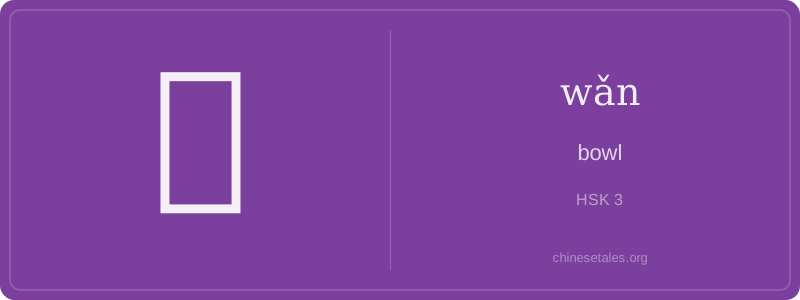
The earliest form of 碗 appears in Warring States bamboo slips—not as a pictograph of a bowl, but as a stylized depiction of a stone container with a wide mouth and curved sides. Its oracle bone roots are debated, but bronze inscriptions show a clear 'stone' (石) radical on the left, anchoring its material origin, and a right side evolving from 口 (mouth/rim) plus 元 (originally 'head', here suggesting the rounded, cap-like shape of a bowl’s profile). Over centuries, the top stroke of 元 simplified, the inner strokes compacted, and the lower part stabilized into the modern '夂' (a variant of 'zhǐ', meaning 'to go'), which visually echoes the gentle downward curve of a bowl’s base—making the whole character a subtle silhouette of a stone bowl resting on a surface.
By the Han dynasty, 碗 had fully displaced earlier terms like 盉 (hé) for everyday eating vessels, appearing in texts like the *Shuōwén Jiězì* as 'a vessel for holding food, made of stone or clay'. Interestingly, its association with stone (石) wasn’t literal—most ancient bowls were ceramic—but reflected the durability and permanence valued in ritual objects. The character’s stability in form over 2,000 years mirrors its role in daily life: unchanged, essential, and quietly dignified—like the humble bowl itself, holding history one meal at a time.
Think of 碗 (wǎn) as the Chinese cousin of the Western ceramic mug—but with far more gravitas. In English, 'bowl' is neutral and functional; in Chinese, 碗 carries quiet cultural weight: it’s not just a vessel, it’s a symbol of sustenance, hospitality, and even fate (as in the idiom '饭碗'—literally 'rice bowl', meaning one’s livelihood). Unlike English nouns that float freely, 碗 often appears with measure words: you don’t say 'one bowl', you say 'yī gè wǎn' (one *ge* bowl)—and crucially, 'gè' is only used for bowls when they’re empty or generic; if it’s full of soup, you’ll likely use 'yī wǎn tāng' (one *bowl* of soup), where 'wǎn' itself becomes the measure word—yes, the noun doubles as a classifier! Learners often mistakenly use 'gè' even when 'wǎn' is required as the counter, leading to unnatural phrasing like '*yī gè tāng*' instead of the correct 'yī wǎn tāng'.
This dual role—as noun *and* measure word—is rare among HSK 3 characters and reflects how deeply utensils are woven into Chinese grammar. You’ll also hear 碗 in fixed expressions like '碰碗' (clinking bowls during toasts), a gesture older than champagne flutes and just as heartfelt. Mispronouncing the third tone (wǎn, not wān or wàn) can shift meaning subtly: 'wān' sounds like 'bend', while 'wàn' means 'ten thousand'—so saying 'wàn' accidentally might make your host think you want ten thousand bowls!
Culturally, offering someone a clean, warm 碗 is an unspoken vow of care—especially in northern China, where elders still hand down heirloom porcelain bowls across generations. And here’s a subtle trap: 碗 is rarely used for modern plastic or paper bowls in formal speech; those are usually called '一次性碗' (yī cì xìng wǎn, 'disposable bowls')—the bare character 碗 implies something durable, intimate, and worthy of respect.