空
Character Story & Explanation
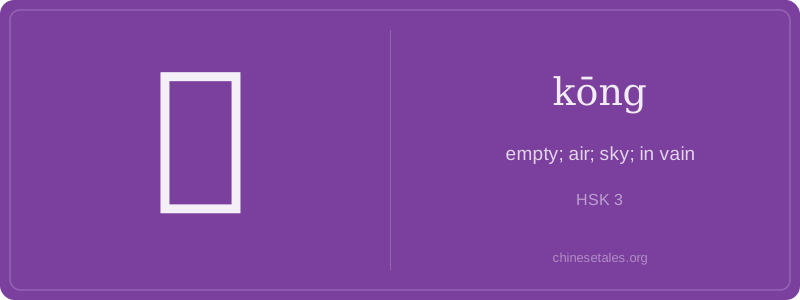
The earliest form of 空 appears in bronze inscriptions as a stylized cave: a rounded arch (representing the entrance) with a horizontal line inside — symbolizing the interior space. Over centuries, the arch evolved into the modern 穴 (cave/hole) radical at the top, while the inner line morphed into 工, likely through simplification and standardization during the Qin dynasty’s script unification. The eight strokes we write today aren’t arbitrary — they preserve that ancient sense of containment: the cave radical frames the emptiness, and 工 subtly reinforces the idea of a *deliberately shaped* void, not random absence.
This visual logic shaped its meaning evolution. In the *Shuōwén Jiězì* (100 CE), 空 was defined as 'a cave where wind passes freely' — linking emptiness to movement and breath. By the Tang dynasty, poets like Li Bai used 空 to evoke transcendent stillness: 'The mountain path is long and empty' (山径空悠长), where 空 conveys both physical desolation and meditative spaciousness. Even today, the character’s shape invites you to 'see through it' — the open center of 穴 mirrors the open meaning, making it one of Chinese writing’s most elegantly self-illustrating characters.
At its heart, 空 (kōng) is a character of absence and openness — but not just 'empty' like an empty box. It’s the hush before thunder, the vastness of sky, the quiet after a thought dissolves. Its radical 穴 (xué, 'cave' or 'hole') anchors it in physical space — a hollow, sheltered opening — while the top component 工 (gōng, 'work' or 'tool') originally hinted at structure or framework, suggesting *a defined emptiness*, not chaos. This duality explains why 空 can mean both tangible void (an empty room) and abstract concepts (空话 kōnghuà — 'empty words', i.e., insincere talk).
Grammatically, 空 shines as an adjective ('This cup is kōng'), a noun ('Look at the kōng!'), and even an adverb ('He ran kōng-handed'). Watch out: when used before verbs, it often implies futility — e.g., 空想 (kōngxiǎng, 'to daydream') literally means 'empty-thinking'. Learners mistakenly treat it like English 'empty' and say *kōng de shū* for 'empty book' — but that’s unnatural; instead, use *kōng shū* (noun compound) or *shū shì kōng de* (subject-predicate). Also, don’t forget kòng (4th tone): it appears in verbs like 空出 (kòngchū, 'to free up space') — same character, different grammatical role.
Culturally, 空 carries Daoist and Buddhist weight: in Chan (Zen) Buddhism, 空 (kōng) isn’t nihilism — it’s the insight that all things lack fixed, independent existence. That’s why 空 hand (kōngshǒu) means 'unarmed' (literally 'empty-hand'), evoking readiness without attachment. A common blunder? Confusing 空 with 虚 (xū, 'hollow, false') — while both imply insubstantiality, 虚 suggests weakness or falsehood (虚心 xūxīn, 'modesty'), whereas 空 emphasizes openness or potential. Mastering 空 means embracing both its concrete breathability and its philosophical depth.