答
Character Story & Explanation
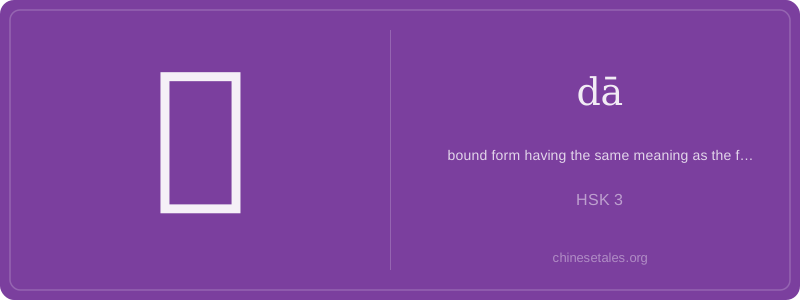
The earliest form of 答 appears in bronze inscriptions around 1000 BCE: a stylized bamboo slip (⺮) stacked atop 合 (hé, ‘to close’ or ‘to join’), suggesting two surfaces coming together — like a lid sealing a box, or a reply closing the loop of a question. Over centuries, 合 simplified into 人 + 一 + 口 (a person speaking one word), while the bamboo radical remained prominent at the top — visually anchoring the idea of a *deliberate, recorded response*. By the Han dynasty, the shape stabilized into today’s 12-stroke form: six strokes for ⺮, then six more for the lower component.
This ‘closing’ motif carried deep cultural resonance: in classical texts like the *Analects*, answering wasn’t just verbal — it was ethical reciprocity. Confucius praised those who ‘answered with sincerity’ (答之以誠), treating speech as a moral contract. Even today, 答應 implies social obligation — agreeing isn’t casual; it’s a small vow. The bamboo radical subtly reinforces this: bamboo was the primary writing medium for official documents and promises in ancient China, so 答 is, etymologically, ‘a pledged reply written on bamboo’.
At its heart, 答 (dā) isn’t just ‘to answer’ — it’s the *act of responding with intention*, like handing back a bow after receiving one. Unlike the neutral verb 回答 (huí dá), which means ‘to reply’, 答 carries quiet weight: it implies acceptance, acknowledgment, or commitment — especially in fixed compounds like 答應 (dā yìng, ‘to agree’). Think of it as the linguistic equivalent of nodding firmly and saying ‘Yes, I’ll do it.’
Grammatically, 答 almost never stands alone in modern spoken Mandarin — you won’t say ‘我答’ to mean ‘I answered’. Instead, it appears bound: in 答應 (dā yìng, ‘to promise/agree’), 答理 (dā li, ‘to acknowledge/pay attention to’), or 答覆 (dá fù, formal ‘to reply’). Notice the tone shift: in 答應 it’s dā (first tone), but in 答覆 it’s dá (second tone) — a subtle clue that pronunciation reflects grammatical role and register.
Learners often overuse 答 as a standalone verb (e.g., *‘Wǒ dá le tā de wèntí’*), but native speakers would say 我回答了 or 我给了答复. Also, don’t confuse it with 達 (dá, ‘to reach’) — same pinyin, totally different meaning and radical! The bamboo radical (⺮) hints at its ancient link to writing: early answers were inscribed on bamboo slips, making this character literally ‘a written response on bamboo’.