箱
Character Story & Explanation
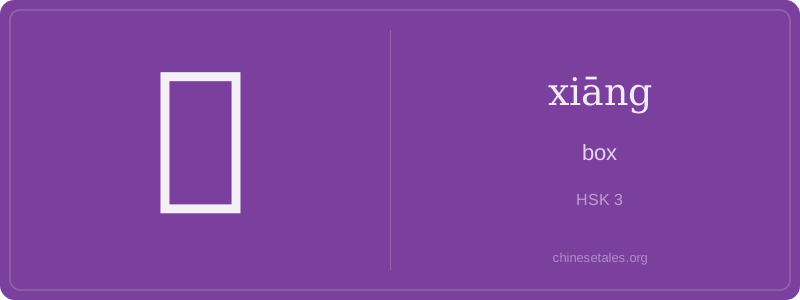
The earliest form of 箱 appears in seal script (c. 3rd century BCE), where it clearly shows a bamboo radical (⺮) atop a phonetic component '相' (xiāng) — which itself originally depicted a person looking at a tree (木 + 目). But here, 相 isn’t about 'looking'; it’s borrowed for its sound and shape to suggest 'enclosure'. Over time, the top evolved into the modern bamboo radical ⺮ (hinting at early boxes made from woven bamboo), while the bottom solidified into 相 — now purely phonetic, though visually echoing 'a space held between two sides'.
This character wasn’t in oracle bones — boxes were too perishable to leave archaeological traces then — but by the Warring States period, bamboo-bound chests were vital for storing silk, documents, and ritual bronzes. In the Book of Rites, 箱 refers specifically to lacquered chest-carriers used in ceremonies. The visual harmony — vertical bamboo strokes framing the balanced, symmetrical 相 — mirrors how traditional Chinese boxes were built: strong, symmetrical, and designed to protect what matters most inside.
Think of 箱 (xiāng) not just as 'box' but as a *container with intention* — something sturdy, purpose-built, and often closed. In Chinese, it implies containment with care: luggage, toolboxes, even metaphorical 'boxes' like email inboxes (收件箱 shōujiàn xiāng). Unlike generic containers like 盒 (hé, a smaller, often open or decorative box), 箱 suggests structure, capacity, and portability — you’d carry a 行李箱 (xínglǐ xiāng), not a 行李盒.
Grammatically, 箱 is a noun that can be modified by measure words like 个 (gè) or more precisely 一只 (yì zhī) for smaller boxes or 一个 (yí gè) for general use. Crucially, it’s also used in compound nouns where English might use adjectives — e.g., 冰箱 (bīng xiāng, 'ice-box' = refrigerator), not 'cold box'. Learners often mistakenly say *冷箱* (lěng xiāng) thinking 'cold box', but that’s not a real word — the cultural logic is historical (ice was used for refrigeration), not descriptive.
Culturally, 箱 carries quiet dignity: wedding dowries arrive in ornate 箱, opera performers’ costumes live in carved 箱, and even digital 'inboxes' retain this sense of curated, secure storage. A common mistake? Using 箱 for small, flimsy containers — if it folds flat or holds snacks, it’s probably a 盒. Also, avoid confusing it with similar-sounding words like 相 (xiāng, 'mutual') — tone and context are your friends!