者
Character Story & Explanation
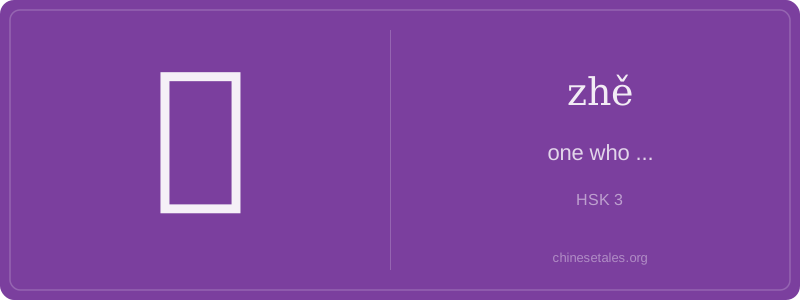
Look closely at 者: the top is 耂 (lǎo), an ancient radical meaning ‘elder’, originally drawn as a stooped figure with long hair and a cane — a bent back (), flowing locks (丿丶), and staff (一). Below sits 日 (rì, ‘sun’), but in early bronze inscriptions, this lower part wasn’t 日 — it was actually 止 (zhǐ, ‘foot’), stylized over centuries into today’s ‘sun-like’ shape. So the earliest form pictured an elder walking (or standing purposefully), embodying wisdom-in-action. By the Warring States period, the foot morphed into 日, possibly because scribes associated ‘elder’ with ‘day’ (as in ‘life span’) or simply due to cursive simplification.
This visual evolution mirrors semantic deepening: from a concrete ‘elder man’ in oracle bones, 者 became a grammatical tool in Classical Chinese — a nominalizing particle marking agents, roles, or categories. Mencius used it constantly: ‘shàn zhě, rén zhī xīn yě’ (‘Goodness is the heart of humanity’), where 者 anchors the definition. Its enduring power lies in how its shape — rooted in reverence for age and experience — now serves abstract logic. Even today, when we write jiàoshī zhě (‘teacher’), we’re invoking millennia of linking knowledge with lived authority.
At its heart, 者 (zhě) is the Chinese language’s elegant way of turning verbs or adjectives into ‘person labels’ — like English’s -er or -ist suffixes. But unlike English, it doesn’t attach to words; it *follows* them, creating a noun phrase: ‘one who [does X]’ or ‘a person characterized by [X]’. It feels philosophical, even respectful — never casual. You won’t say ‘coffee-drinker’ as kāfēi hē zhě in daily chat; you’ll use it in written or formal speech: yǒu jīngyàn zhě (‘an experienced person’), not ‘someone who has experience’.
Grammatically, 者 is a nominalizer — it turns entire ideas into nouns. It pairs with adjectives (cōngmíng zhě = ‘the intelligent one’), verbs (tǎotèn zhě = ‘the troublemaker’), or even whole clauses (bù néng wánchéng rènwù zhě = ‘those who cannot complete the task’). Crucially, it’s almost always used with another noun or modifier before it — never alone. Learners often mistakenly treat it like a pronoun (e.g., saying *zhě shì wǒ* — ‘he is the one’), but that’s unnatural; native speakers prefer tā or zhè ge rén. Also, it rarely appears in spoken Mandarin without context — it’s more at home in news headlines, essays, or classical-style phrasing.
Culturally, 者 carries quiet gravitas — think of Confucius’s ‘jūnzǐ zhě…’ (‘The noble person is…’) or modern policy documents listing ‘xīn rù zhě’ (new entrants) or ‘lǎo nián zhě’ (elderly people). It subtly reinforces China’s tradition of defining identity through role and action rather than abstract selfhood. A common learner trap? Overusing it trying to sound ‘advanced’ — but native speakers reach for simpler terms like rén, xiǎo zǔ, or just omitting the label entirely. Less is more — unless you’re writing a white paper on public health policy.