聊
Character Story & Explanation
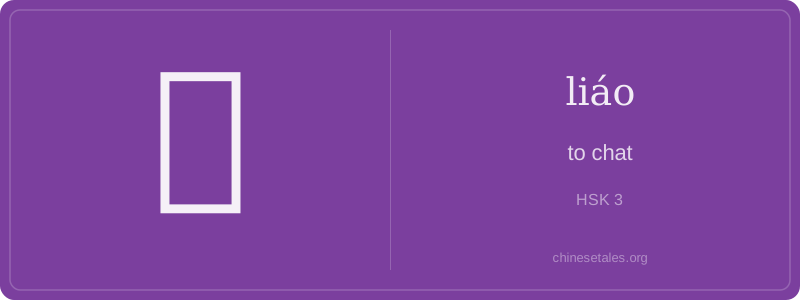
The earliest form of 聊 appears in seal script (c. 3rd century BCE) as two components stacked: 耳 (ěr, ‘ear’) on top and 火 (huǒ, ‘fire’) below — but wait! That ‘fire’ later morphed into 丿 (a falling stroke) + 一 (horizontal) + 习 (xí) through clerical script simplification. Actually, the lower part evolved from 尥 (liào), an old variant meaning ‘to toss, to fling’ — picturing words tossed back and forth like sparks flying between ears. Over centuries, the fire-like energy of verbal exchange softened into the gentle flicker we see today: 耳 (listening) + 亠 (cover/head) + 丿一习 (a stylized gesture of speaking freely).
This visual duality — ear and expressive motion — perfectly mirrors its semantic journey. In the *Book of Songs*, 聊 first appeared in the phrase 聊乐我员 (liáo lè wǒ yuán), meaning ‘just to delight us’, suggesting a light, provisional action — not commitment, but comfort. By the Ming dynasty, it settled into its modern sense in vernacular novels like *Jin Ping Mei*, where characters constantly 聊闲天 (liáo xián tiān, ‘chat idly’) — reinforcing its identity as speech without agenda, rooted in presence, not purpose.
Think of 聊 (liáo) as Chinese’s cozy, low-stakes version of 'chat' — like swapping stories over coffee rather than debating philosophy in a seminar. It implies relaxed, informal conversation, often with no urgent purpose: not negotiating, not reporting, just connecting. Unlike English 'talk', which can be formal ('Let’s talk business'), 聊 is inherently warm and unstructured — you 聊天 (liáo tiān), never *聊工作* (unless jokingly!). It’s almost always transitive: you 聊 *something* (e.g., 聊电影) or 聊 *with someone* (e.g., 跟朋友聊).
Grammatically, it’s beautifully simple at HSK 3: use it as a verb with object or complement, often in the present/future tense or with aspect particles like 过 or 了. Watch out — learners sometimes overuse it like English 'talk' and say *我聊英语* (‘I talk English’), but that’s unnatural; instead, say 我说英语 or 我用英语聊天. Also, 聊 is rarely used alone in commands — you’d say 咱们聊聊天吧 (let’s chat a bit), not just *聊!* — because its core vibe is mutual, gentle, and extended.
Culturally, 聊 carries the quiet weight of traditional social harmony: it’s the linguistic equivalent of offering tea before diving into serious matters. In classical texts, it appeared in phrases like 聊以自慰 (liáo yǐ zì wèi — ‘to console oneself lightly’), revealing its ancient nuance of ‘doing something modestly, just enough’. Modern learners miss this subtlety when they translate it too literally as ‘chat’ — it’s less about content, more about the shared, unhurried rhythm of human connection.