街
Character Story & Explanation
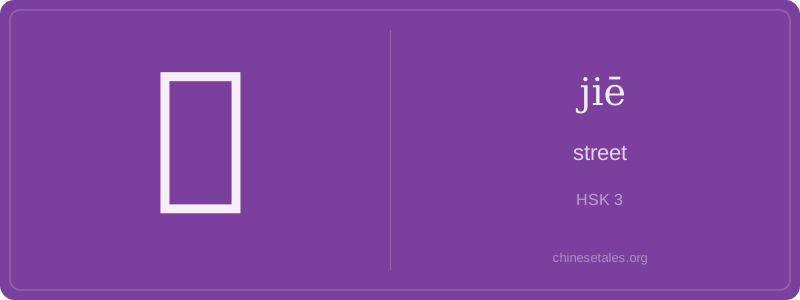
The earliest form of 街 appears in Han dynasty seal script — not as a pictograph, but as a semantic-phonetic compound. Its left side 行 (xíng) was already a walking radical, originally depicting two intersecting paths (like a crossroads). The right side 卫 (wèi, later simplified to 圭-like shape) wasn’t a picture of soldiers — that’s a myth — but a phonetic hint, borrowed from an ancient word sounding like 'gāi' (later shifting to jiē). Over centuries, the right component evolved from 卫 to 圭 and finally to the modern simplified shape, losing its original phonetic clarity but gaining visual balance.
By the Tang dynasty, 街 had solidified its meaning as 'a public thoroughfare lined with buildings and shops', distinct from rural paths (径 jìng) or imperial avenues (道 dào). Classical texts like the *Tang Liudian* describe 'twelve main 街 in Chang’an', each over 100 meters wide and bustling with markets — confirming 街’s early association with commerce and communal life. Crucially, the character’s structure mirrors its function: 行 on the left signals motion and passage, while the right side grounds it in human settlement — not just 'walking', but 'walking among people'. That duality remains embedded in every modern usage.
At its heart, 街 (jiē) isn’t just a neutral 'street' — it’s a social artery. In Chinese, streets aren’t merely asphalt; they’re living spaces where vendors shout, elders play chess, children chase bubbles, and neighbors exchange gossip over steaming baozi. That’s why 街 often appears in warm, concrete contexts: not 'the street exists', but 'on the street, something human is happening'. You’ll rarely see it as a subject alone — it almost always pairs with location words (on, along, near) or verbs of movement and activity.
Grammatically, 街 behaves like a noun but demands spatial framing: you say 在街上 (zài jiē shàng, 'on the street'), 沿着街 (yán zhe jiē, 'along the street'), or 街口 (jiē kǒu, 'street corner') — never just 'I walk street'. Learners often mistakenly omit the particle 上 or use 街 as a verb ('to street'), which doesn’t exist. Also, unlike English 'street', 街 rarely carries formal or administrative weight — for official road names, 路 (lù) or 道 (dào) are more common; 街 feels local, familiar, lived-in.
Culturally, 街 evokes the rhythm of everyday urban life — think Beijing’s hutong alleys or Chengdu’s teahouse-lined lanes. It’s the stage for both mundane errands and spontaneous festivals. A common mistake? Assuming all 'streets' are 街: while Shanghai’s Nanjing *Lu* is famous, it’s 路 — not 街 — because 路 implies thoroughfare function, whereas 街 implies community texture. Mastering 街 means learning to read the city not as infrastructure, but as shared human habitat.