解
Character Story & Explanation
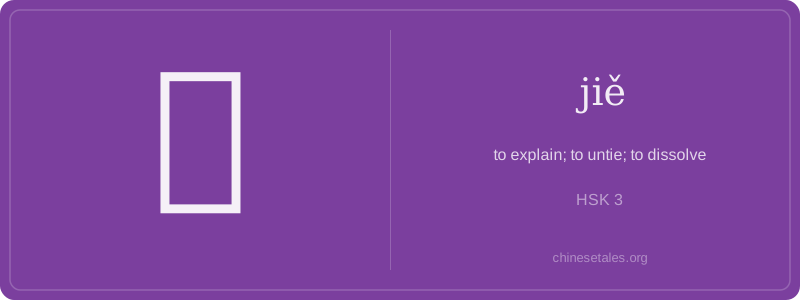
The earliest form of 解 appears in bronze inscriptions as a vivid pictograph: two hands (爫) flanking a horned head (角), with a knife (刀) beneath — literally ‘cutting apart the horns’. It depicted the ancient ritual of dismembering a sacrificial ox: separating the horns from the skull, symbolizing division, separation, and release. Over time, the hands simplified into the top-left component (⺈ + 冂), the horn became 角 (its radical), and the knife evolved into the bottom-right 剌-like shape — though today’s lower part looks more like 牛 (cow) plus 刀, preserving the original ‘cutting animal parts’ logic.
This visceral origin explains why 解 branched so powerfully: from physically cutting apart → loosening ties → dissolving substances → clarifying ideas. By the Warring States period, Mencius used 解 in ‘解人之惑’ (‘dispel people’s confusion’), cementing its intellectual sense. Even today, the character’s visual weight — 13 strokes, angular and decisive — mirrors its function: no gentle suggestion, but a clean, intentional act of release or clarification.
Think of 解 (jiě) as the Chinese verb for ‘un-knotting’ — not just ropes, but confusion, tension, or even chemical bonds. Its core feeling is *release through understanding*: to untie a knot, explain a riddle, dissolve sugar in tea, or resolve a conflict. That’s why it works across physical, intellectual, and emotional realms — a rare semantic breadth that feels deeply human. Notice how naturally it pairs with objects: 解释 (explain something), 解开 (untie something), 解决 (solve something), 解散 (disband something).
Grammatically, it’s wonderfully flexible. As a transitive verb, it almost always takes an object (e.g., 解这个问题 — 'solve this problem'). But watch out: when used in the common pattern ‘把…解…’ (bǎ…jiě…), learners often omit the object particle 把 or misplace the complement — like saying *‘wǒ jiě kāi mén’* instead of the correct *‘wǒ bǎ mén jiě kāi le’* (I unlocked the door). Also, don’t confuse its active voice with passive-looking forms — 解 is rarely passive; it’s always about *you* doing the untying.
Culturally, 解 carries quiet authority: in classical texts, sages ‘解经’ (interpret the classics), and in modern life, doctors ‘解毒’ (detoxify) and teachers ‘解题’ (work through problems step-by-step). A frequent learner mistake? Using 解 for ‘understand’ — that’s 懂 (dǒng) or 理解 (lǐjiě). 解 means *to make understandable*, not to *be* understandable. And yes — it *can* be jiè (as in 百官解职 — officials resigning) or xiè (in surnames like 解缙), but at HSK 3, jiě is your only priority.