该
Character Story & Explanation
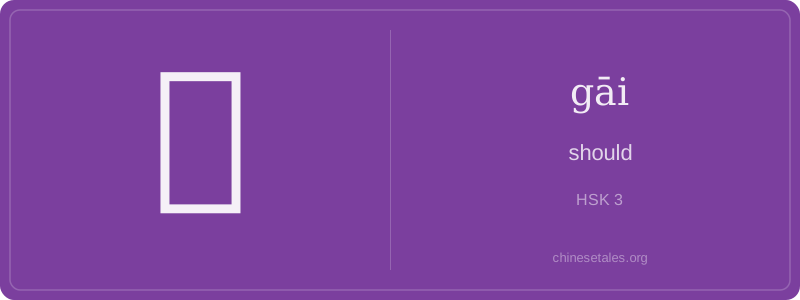
The earliest form of 该 appears in Han dynasty clerical script, evolving from the ancient character 該 — itself a phonosemantic compound. Its left side 讠 (speech radical) signals language-related meaning; its right side 骇 (hài, ‘to frighten’) was originally a simplified phonetic hint, but over centuries, the right side morphed into ‘亥’ (hài, the 12th Earthly Branch) — a common phonetic component. Visually, the modern 该 looks clean: two strokes for the speech radical (讠), then six strokes forming ‘亥’: a horizontal stroke, a short diagonal, a curved hook, and three compact dots — like a tiny, decisive fingerprint pressed beside words.
This character didn’t exist in oracle bones — it emerged later, during the Warring States period, as written Chinese expanded to express abstract social concepts. In classical texts like the Mencius, forms like ‘該’ appear in phrases meaning ‘to cover all cases’ or ‘to include comprehensively’ — hence its core sense of ‘what applies universally in this context.’ By Tang dynasty poetry and Song legal documents, it had narrowed to ‘what is fitting, due, or incumbent upon someone.’ The shift from ‘comprehensiveness’ to ‘obligation’ mirrors how Chinese ethics locates duty not in absolute law, but in precise, context-aware appropriateness — exactly what 该 conveys today.
Imagine you’re at a Beijing teahouse, and your friend Li Wei leans in, pointing to your half-finished cup: ‘Nǐ gāi hē wán zhè bēi chá le.’ (You should finish this cup of tea.) That little word gāi isn’t bossy — it’s warm, responsible, quietly insistent. It carries the weight of shared expectation: not command, but gentle moral logic — what’s appropriate, reasonable, or due given the situation. It’s the linguistic equivalent of a nod from an elder: not ‘you must,’ but ‘of course you will — because you’re thoughtful, capable, and part of this human web.’
Grammatically, gāi is a modal verb that always comes before the main verb (e.g., gāi qù, gāi zhīdào) and never stands alone. Unlike English ‘should,’ it rarely expresses doubt or regret — no ‘I should have gone’ (that’s yīnggāi yǐjīng qù le, but learners often overuse gāi here; better use běn yīnggāi for past obligation). Also, gāi can’t be negated with bù — you say bù gāi (not *bù yīnggāi*), but that’s actually HSK 4 level nuance; at HSK 3, stick to bù gāi for simple prohibition.
Culturally, gāi reflects Confucian relational ethics: duty arises from role and context — a student gāi respect teachers, a host gāi serve tea first. Learners often confuse it with yīnggāi (which is more formal/stronger) or omit it entirely, making suggestions sound abrupt (‘Qù ba!’ vs. ‘Nǐ gāi qù.’). Remember: gāi adds quiet gravity — like sprinkling sesame oil on soup: subtle, but essential for depth.