趣
Character Story & Explanation
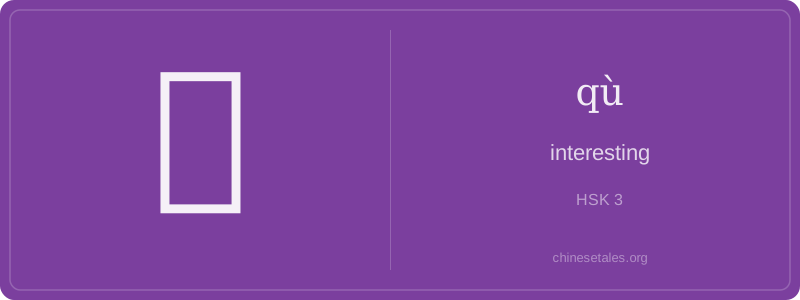
The earliest form of 趣 appears in bronze inscriptions around 800 BCE — not as a pictograph of ‘fun’, but as a compound: the left side was 取 (qǔ, ‘to take’), and the right was 走 (zǒu, ‘to walk/run’), written with a simplified foot radical. This wasn’t about amusement — it depicted the act of *hurrying to take something*, like rushing toward a prize or seizing an opportunity. Over centuries, the 取 component evolved: its top (耳 ěr, ‘ear’) and bottom (又 yòu, ‘again/hand’) merged into today’s 曲 (qū) shape, while the 走 radical stayed proudly at the bottom, anchoring the character in motion.
This visual journey explains its semantic shift: from ‘hurrying to take’ → ‘what draws you in’ → ‘that which attracts or delights’. By the Han dynasty, 趣 was already used for ‘interest’ and ‘pleasure’, especially in philosophical and literary contexts. The Tang poet Bai Juyi wrote of finding inner peace through simple joys — calling them ‘清趣’ (qīngqù, ‘pure, refined charm’). Even today, the walking radical 走 reminds us that interest isn’t passive — it’s something we *move toward*, actively choosing what captures our attention and heart.
At its heart, 趣 (qù) isn’t just ‘interesting’ — it’s the spark of *delightful engagement*: the joy of discovery, the charm of a quirky detail, or the quiet pleasure of doing something for its own sake. Think of it as ‘interest with soul’ — not dry curiosity (that’s 好奇 hàoqí), but warmth, personality, and personal resonance. You’ll rarely see it alone; it almost always appears in compounds like 有趣 (yǒu qù) or 趣味 (qùwèi), where it adds emotional texture.
Grammatically, 趣 is never used as a standalone adjective like ‘interesting’ in English. You can’t say *‘这个很趣’ — that’s ungrammatical. Instead, it partners with verbs: 有 (yǒu) → 有趣 (yǒu qù, ‘has interest/charm’); or forms nouns: 趣味 (qùwèi, ‘interest’, ‘taste’, ‘flavor’). Learners often mistakenly treat it like an i-adjective — but it’s a noun-root that needs support. Bonus tip: when describing someone’s personality, 趣 is almost always bundled — e.g., 他很有幽默感,也很有趣 (Tā hěn yǒu yōumò gǎn, yě hěn yǒu qù).
Culturally, 趣 carries a subtle Confucian-tinged elegance — it implies refined appreciation, not just surface-level fun. In classical texts, it often describes aesthetic or intellectual delight (e.g., 陶渊明’s love of nature was full of 真趣 — ‘genuine, unpretentious charm’). A common error? Over-translating 有趣 as ‘funny’ — no! It’s closer to ‘engaging’, ‘charming’, or ‘full of appeal’. And watch out: in formal writing, 趣 can mean ‘tendency’ or ‘inclination’ (as in 兴趣 xìngqù), adding a layer of intentionality beyond mere amusement.