较
Character Story & Explanation
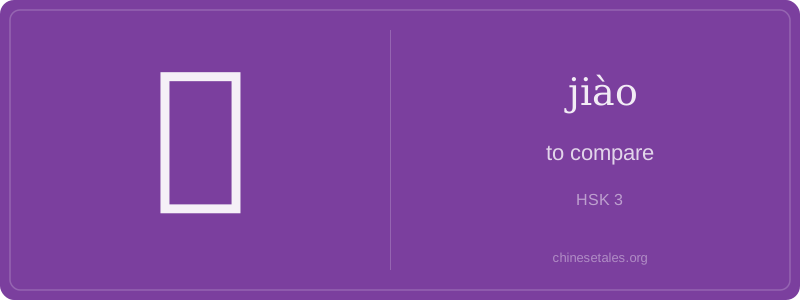
The earliest form of 较 appears in bronze inscriptions as a compound pictograph: left side 車 (chē, 'chariot'), right side 交 (jiāo, 'to cross, intertwine'). Imagine two ancient war chariots locked in a maneuver — wheels crossing, axles aligned, drivers assessing speed and position mid-battle. This wasn’t just 'looking at both' — it was tactical measurement, real-time calibration. Over centuries, the right side simplified from 交 (two crossed legs + legs) to the modern 交 component, while the left retained the full 车 radical — no stroke reduction, emphasizing its core link to motion, mechanism, and precision engineering.
By the Warring States period, 较 evolved from literal chariot assessment to abstract evaluation — first in military strategy (e.g., assessing terrain advantage), then in philosophy (Mencius uses 较 to weigh virtues). The character’s enduring visual logic is striking: a vehicle (車) paired with crossing/intertwining (交) implies *dynamic interaction between moving parts* — exactly how comparison works: two elements must engage, intersect, and be measured against each other. This mechanical origin explains why 较 feels more objective and calibrated than synonyms like 比 — it’s less about simple likeness and more about functional, measurable difference.
At its heart, 较 (jiào) is all about *measuring difference* — not just 'comparing' in a neutral sense, but weighing, assessing, and judging relative value or degree. Think of it as the Chinese equivalent of putting two things on a mental scale: 'Which is heavier? Faster? Better? More intense?' It’s never used alone; it always appears in structures like 较…(为)… ('relatively…'), 较多/较少 ('relatively more/fewer'), or in compound verbs like 比较 (bǐjiào), where it adds precision and formality.
Grammatically, 较 is a classic 'degree adverb' — it modifies adjectives or verbs to express *relative comparison*, often implying objectivity or measured judgment. You’ll rarely hear it in casual speech ('This coffee’s stronger!' → 这咖啡更浓!), but it’s everywhere in news, reports, and academic writing: 'The economy grew at a relatively faster rate' → 经济增长速度相对较快。Crucially, 较 cannot introduce a direct comparison with 'than' (that’s 更’s job); saying 'A 较 B 好' is grammatically wrong — learners often slip into this because of English interference.
Culturally, 较 carries quiet authority — it signals careful evaluation, not personal opinion. In classical texts like the Mencius, it appears in discussions of moral discernment (e.g., 较然可见 — 'clearly distinguishable'). Modern learners mistakenly use it like English 'compare' as a verb (e.g., *I 较 this book*), but it functions almost exclusively as an adverbial modifier. Its formality also means it’s avoided in spoken Mandarin unless you’re aiming for bureaucratic or scholarly tone — a nuance that trips up even advanced students.