邮
Character Story & Explanation
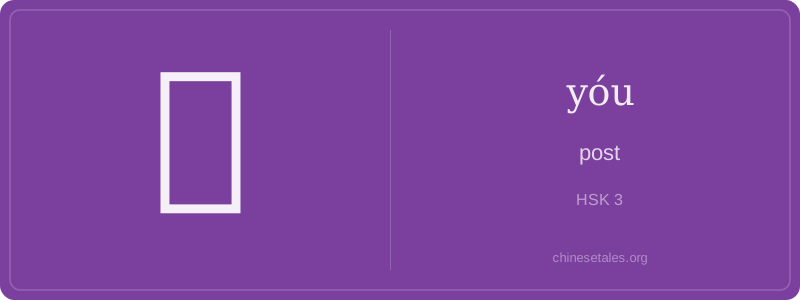
The earliest form of 邮 appears in seal script (c. 3rd century BCE), not oracle bones — it’s relatively young! Its left side, 由 (yóu), was originally a simplified pictograph of a tall flagpole planted in the ground, symbolizing a designated station. The right side, 阝 (a variant of 邑, yì, meaning ‘city’ or ‘settlement’), confirms this was a *place*: specifically, a government relay station along ancient highways where couriers changed horses and passed urgent documents. Over centuries, the flagpole shape simplified into 由 (now pronounced yóu by sound borrowing), while 邑 shrunk and rotated into the familiar ear-shaped 阝 on the right — seven clean strokes total.
This origin explains everything: 邮 wasn’t about letters at first — it was about imperial control, speed, and infrastructure. In the *Zuo Zhuan* (c. 4th century BCE), ‘邮’ refers to these official courier stops, vital for state communication. Only during the Qing dynasty did the term broaden to include civilian mail services, and in 1912, the Republic established the modern ‘postal administration’ (邮政). So when you write 邮, you’re tracing a line from horseback couriers under Confucian bureaucracy to your WeChat-obsessed generation still mailing birthday cards — a tiny character holding millennia of connectivity.
Imagine you’re in a bustling Beijing post office: red banners flutter, clerks stamp letters with a satisfying *thunk*, and a queue snakes past shelves of postage stamps shaped like pandas. That vibrant, slightly chaotic energy — the movement of messages across space and time — is the soul of 邮 (yóu). It doesn’t just mean ‘post’ as a noun; it’s the *action* of sending, the *system* of delivery, and the *place* where mail lives. You’ll see it in verbs like 邮寄 (yóu jì, to mail), nouns like 邮局 (yóu jú, post office), and even adjectives like 邮政 (yóu zhèng, postal). It’s never used alone — you’d never say *‘I bought a 邮’* — it always appears in compounds or with verbs.
Grammatically, 邮 is almost always the first character in two-syllable words and rarely stands solo. Learners often mistakenly treat it like English ‘post’ and try to use it as a verb by itself (e.g., *‘I yóu the letter’*), but that’s ungrammatical — you must say 邮寄 or 邮出. Also, note its radical 阝 (the ‘city’ or ‘area’ radical on the right) — it signals this character belongs to the domain of places, institutions, and administrative systems, not objects or actions in isolation.
Culturally, 邮 carries quiet reverence: before email, handwritten letters sent via 邮政 were lifelines between families separated by work or reform-era migration. Even today, receiving a physical letter feels like a small ritual — slower, more intentional. A common mistake? Confusing it with 友 (yǒu, friend) — same sound family but totally different meaning and radical. Remember: 邮 has the ‘area’ radical (阝) on the right, signaling *institutional space*, while 友 has the ‘hand’ radical (又) and means *person-to-person connection*.