酒
Character Story & Explanation
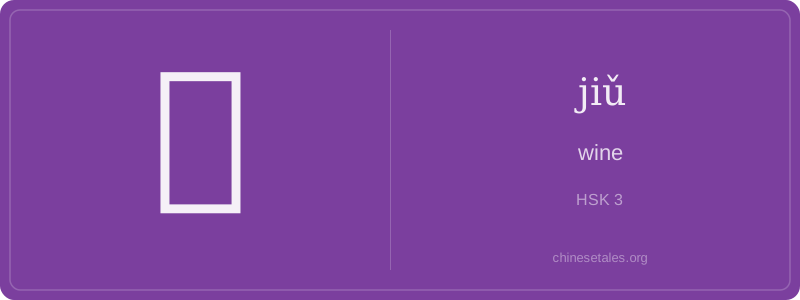
The earliest form of 酒 appears in Shang dynasty oracle bone inscriptions (c. 1200 BCE) as a pictograph: a simple vessel (the precursor to 酉) with three dots inside — representing fermenting grains bubbling with life. Over centuries, the vessel evolved into the standardized ‘wine jar’ radical 酉 (yǒu), while the right side, originally a phonetic element 巛 (chuān, ‘streams’), morphed into 氵+乆 — the modern 九 (jiǔ), chosen for its sound. By the Han dynasty, the character stabilized at 10 strokes: 酉 (7 strokes) + 九 (3 strokes), visually marrying container and sound.
This evolution reflects how deeply alcohol was woven into early Chinese civilization — not as luxury, but as sacred offering, medicine, and staple food preservative. In the Shijing (Book of Odes), 酒 appears in hymns praising ancestors who ‘drank wine in reverence’. Later, in Tang poetry, it became a symbol of freedom and melancholy — Li Bai famously declared, ‘I drink a hundred cups without getting drunk!’ (会须一饮三百杯). The character’s shape — a jar holding transformation — mirrors its cultural role: a vessel for change, connection, and controlled chaos.
At its heart, 酒 (jiǔ) isn’t just ‘wine’ — it’s liquid ritual. In Chinese, it evokes warmth, ceremony, and social glue: a toast at weddings, ancestral offerings, poetic inspiration (Li Bai wrote over 200 poems about it!), or even medicinal use. Unlike English ‘wine’, which often implies grape-based alcohol, 酒 covers *all* fermented alcoholic drinks — rice wine (米酒), sorghum baijiu (白酒), even plum wine (梅酒). It feels earthy, communal, and slightly solemn — never frivolous.
Grammatically, 酒 is a noun that rarely stands alone in speech; you’ll almost always see it in compounds (e.g., 白酒, 啤酒, 酒店) or with measure words like 一杯酒 (yī bēi jiǔ — 'a cup of alcohol'). Crucially, it’s *not* used for non-alcoholic ‘juice’ — that’s 果汁 (guǒzhī). Learners sometimes mistakenly say 我喝酒了 thinking ‘I drank juice’, but no — this means ‘I drank *alcohol*’ — a culturally loaded confession! Also, 酒 can’t be pluralized or modified like an English count noun; you don’t say ‘two wines’ — you specify types or quantities: 两种酒 (liǎng zhǒng jiǔ — ‘two kinds of alcohol’).
Culturally, 酒 carries deep duality: it’s both auspicious (used in rites and diplomacy) and cautionary (Confucius warned against excess, and modern public health campaigns highlight risks). A common mistake? Assuming 酒 = ‘wine’ → translating ‘red wine’ as 红酒 (hóngjiǔ) — correct! — but then misreading 红酒 as ‘red liquor’ and assuming it’s strong spirits. Nope: 红酒 is mild, table-friendly grape wine — while 白酒 is fiery, 50%-60% ABV sorghum spirit. Context is everything.