阳
Character Story & Explanation
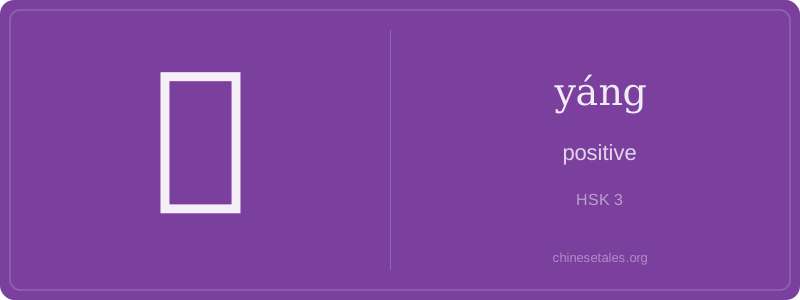
Carved into oracle bones 3,200 years ago, the earliest form of 阳 looked like 日 (sun) above 土 (earth), with a wavy line suggesting radiant heat — a clear visual: sunlight hitting the ground. Over centuries, the sun morphed into the left-side 日 component, while the right side evolved from a phonetic element ‘yáng’ (originally written as 昜) into today’s simplified 阝 (the ‘hill/land’ radical on the right, historically representing terrain where sun first strikes). By the seal script era, it stabilized as 日 + 阝 — literally ‘sun on the hillside’, capturing how morning light first bathes elevated land.
This concrete image seeded its philosophical expansion: in the Yì Jīng (I Ching), yáng became the unbroken line (—), symbolizing creative force and celestial power — contrasted with yīn’s broken line (– –). The character’s shape still echoes that origin: the top stroke of 日 is the sun’s arc; the three dots in 阝? They’re stylized rays cascading down the hillside. Even today, when Chinese say ‘yáng guāng’ (sunlight), they’re invoking that ancient moment — not just photons, but the first warm touch of day on rising land.
Picture this: 阳 isn’t just ‘positive’ — it’s the sun blazing over a mountain ridge at dawn, radiating warmth, light, and life itself. In Chinese cosmology, it’s half of the cosmic dance with yīn (阴), representing activity, brightness, masculinity, and outward energy — think sunlight, summer, fire, or a confident smile. It’s not abstract positivity like English ‘good vibes’; it’s physical, directional, and deeply relational: you can’t have yáng without yīn, just as you can’t have day without night.
Grammatically, 阳 shines in compound words (rarely stands alone) and often pairs with yīn to form conceptual opposites — like yīn-yáng balance in health or philosophy. Learners sometimes mistakenly use it as a standalone adjective meaning ‘positive’ (e.g., *‘This is very yáng!’*), but native speakers say yáng guāng (sunlight), tài jí yáng (Tai Chi’s yang aspect), or yáng xìng (yang nature). It also appears in place names (Luòyáng, Yángzhōu) and medical terms (yáng xū = yang deficiency), where its meaning is contextualized, not literal.
Culturally, 阳 carries quiet authority: it’s in the national flag’s five stars (symbolizing the Party guiding four classes — a yang-centered hierarchy), and in traditional medicine, ‘excess yang’ means feverish restlessness, not virtue. A common mistake? Confusing it with yī (一) or yǐ (已) — but those lack the ear radical and the solar warmth. Remember: 阳 doesn’t mean ‘happy’ — it means ‘sun-powered’, ‘outward-flowing’, ‘life-igniting’.