音
Character Story & Explanation
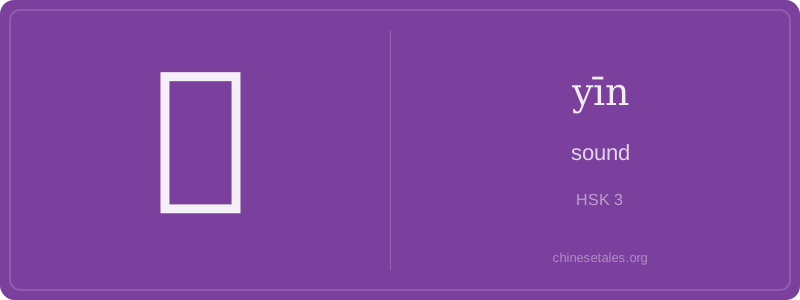
Carved on Shang dynasty oracle bones over 3,000 years ago, the earliest form of 音 looked like a simplified drum (壴) topped with a horizontal line — a visual ‘label’ marking the drum’s resonant output. That top line wasn’t decorative; it was a semantic marker, distinguishing *produced sound* from the physical instrument itself. Over centuries, the drum shape (壴) evolved into today’s upper component — notice how the left vertical stroke, two short horizontals, and right curve echo an ancient drum stand. The bottom part, 日 (rì, ‘sun’), wasn’t about daylight — it represented the *enclosed space* where sound vibrates and resonates, like a sounding chamber.
This elegant duality — instrument + resonance chamber — cemented 音’s core idea: sound as intentional, shaped, and culturally significant. In the *Book of Rites*, ‘yīn’ appears alongside ‘lè’ (music) as one of the highest civilizing forces — not noise, but harmonized vibration that aligns heaven, earth, and humanity. Even today, when Chinese speakers refer to ‘yīn’ in linguistics or music, they subtly invoke that ancient ideal: sound as meaning-bearing, ordered, and deeply human.
At its heart, 音 (yīn) isn’t just ‘sound’ — it’s *intentional*, *structured* sound: the kind that carries meaning, like speech or music. Unlike the more neutral 声 (shēng), which covers any audible vibration (a dog barking, thunder), 音 implies human agency and cultural resonance — think tones in Mandarin, musical notes, or even the ‘voice’ of a text. It’s why we say yīnyuè (music), yīndiào (tone), and yīnfú (phonetic symbol). This nuance trips up learners who translate ‘sound’ too literally: you wouldn’t use 音 for ‘the sound of rain’ — that’s shēng.
Grammatically, 音 is almost never used alone as a noun in modern speech — it’s overwhelmingly bound in compounds (like yīnxiàng for ‘audio recording’ or yīnxiāng for ‘speaker’). You’ll rarely hear someone say ‘this is a yīn’ — instead, it appears in fixed terms or as a suffix meaning ‘-sound’ or ‘-audio’. Interestingly, it also appears in classical set phrases like ‘yīn lǜ’ (musical pitch), where it retains its ancient link to ritual harmony and cosmological order.
Culturally, 音 carries weight beyond acoustics: Confucius praised ‘proper sounds’ (zhèng yīn) as moral anchors, and the ancient ‘Six Arts’ included ‘music’ (yīn lè) as essential to cultivating virtue. Learners often mispronounce it as yìn (falling tone) — but it’s always yīn (first tone, flat and clear, like the pure note it represents!). Also, don’t confuse it with 意 (yì, ‘meaning’) — though they rhyme, they’re worlds apart: one is heard, the other understood.