鸟
Character Story & Explanation
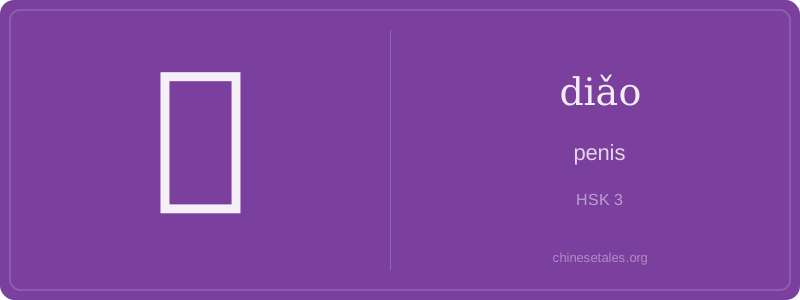
The earliest form of 鸟 appears in Shang dynasty oracle bone inscriptions (~1200 BCE) as a striking pictograph: a clear profile of a bird with a prominent eye, curved beak, flared wing, and trailing tail feathers — sometimes even with feet gripping a branch. Over centuries, the form simplified dramatically: the eye became a dot (丶), the beak and head merged into the top stroke (㇇), the wing condensed into the sweeping horizontal–hook (乚), and the tail evolved into the final dot-like stroke (丶) — all within just five strokes. By the Han dynasty, it had stabilized into the modern shape we write today — elegant, minimal, and still hauntingly birdlike at a glance.
For over two millennia, 鸟 meant only 'bird' — appearing in classics like the Shījīng (Book of Odes) describing 'yellow birds singing in the mulberry trees', and in Daoist texts symbolizing freedom and spontaneity. Its slang meaning emerged only in late imperial vernacular fiction and flourished in 20th-century oral culture, likely because the pronunciation diǎo sounded close to older dialectal taboos and offered a cheeky, deniable way to refer to the male organ using a familiar, innocuous glyph — turning orthographic innocence into linguistic subversion. The character didn’t change; our mouths did.
Let’s start with a jolt: 鸟 (diǎo) is one of the most vivid examples in Chinese of semantic 'shock drift' — where a character’s original meaning (a bird!) gets completely hijacked by slang, leaving its classical form intact but its spoken usage radically transformed. Visually, it’s still unmistakably avian: five strokes evoking a head, eye, wings, and tail — a stylized bird perched on a line. But in modern colloquial speech, especially among young adults and in informal writing (text messages, online forums, comedy), diǎo almost exclusively means 'penis' — blunt, earthy, and often used for emphasis or comic exaggeration ('This traffic is so slow — diǎo!'). It’s never used in formal contexts, medical settings, or polite conversation.
Grammatically, it functions as a noun, frequently reduplicated (diǎo diǎo) for playful or dismissive effect, or embedded in idiomatic expressions like 'niǎo cháo' (bird nest) — which *can* mean an actual nest when pronounced niǎo, but becomes vulgar slang if mispronounced diǎo cháo. Learners must treat pronunciation as a hard switch: niǎo = bird (HSK 1, neutral); diǎo = taboo slang (not in textbooks, but heard everywhere). Mispronouncing niǎo as diǎo — even accidentally — can derail a conversation instantly.
Culturally, this shift likely emerged from phonetic resemblance to older vulgar terms and the visual absurdity of applying a harmless animal glyph to something taboo — a classic case of Chinese ‘euphemistic camouflage’. The character isn’t taught as ‘penis’ in schools or dictionaries; it’s acquired through immersion, making it a silent rite of passage for learners. Your safest rule? When you see 鸟, ask: Is this written in a textbook, a nature documentary subtitle, or a meme caption? That context tells you whether it’s soaring — or swearing.