有
Character Story & Explanation
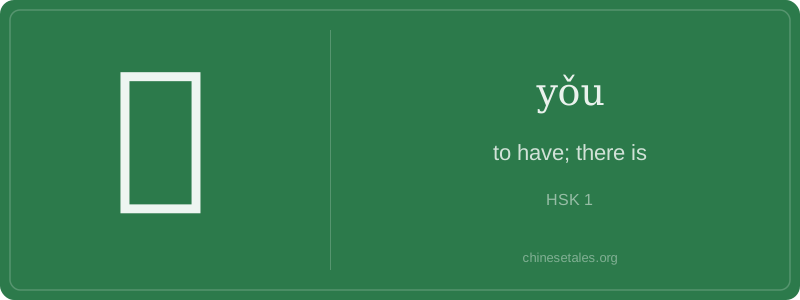
The earliest form of 有 appears in oracle bone inscriptions as a hand (又, yòu) holding a piece of meat — literally ‘to hold meat’, symbolizing possession, sustenance, and material wealth. Over centuries, the meat evolved into the ‘moon’ radical 月 (originally 肉 ròu, ‘flesh’, which looked nearly identical and later merged visually with 月), while the hand 又 simplified and rotated slightly, becoming the top-left stroke cluster. By the small seal script, it had stabilized into the six-stroke shape we know — still echoing that ancient gesture of grasping something vital and real.
This visceral origin explains why 有 never strayed into abstract ‘being’: Confucius used it in the Analects to denote tangible virtue (‘Yǒu dé zhě bì yǒu yán’ — ‘One who has virtue must have words’), and classical poetry employed it to assert presence against emptiness (‘Shān zhōng yǒu guì shù’ — ‘In the mountains there is a cassia tree’). Even today, the character’s shape whispers its history — those top strokes like fingers curling around the ‘flesh’ below, reminding us that to ‘have’ in Chinese is first and foremost to *hold*, *contain*, and *sustain*.
Imagine you’re at a Beijing hutong snack stall, and the vendor holds up two steamed buns — one plain, one stuffed with red bean paste. She points to the filled one and says, 'Yǒu tián dòu shā!' ('Has sweet bean paste!'). That ‘has’ isn’t just possession — it’s presence, existence, even potential: the bun *contains*, *features*, *boasts* something real and tangible. That’s the soul of 有: not passive ownership like ‘I own a car’, but active, observable *having* or *there-is-ness*. It’s how Chinese expresses existence without a verb ‘to be’ — ‘There is a cat on the table’ becomes ‘Zhuōzi shàng yǒu yī zhī māo’.
Grammatically, 有 is refreshingly straightforward — no tense markers, no conjugations. Want past? Add ‘le’: ‘Wǒ yǒu le yī běn xīn shū’ (I have got a new book). Future? Just context: ‘Míngtiān wǒ yǒu kǎo shì’ (Tomorrow I have an exam). But watch out: you *cannot* use 有 for states or qualities — never say ‘Wǒ yǒu gāo’ for ‘I am tall’. That’s where learners trip — 有 only handles concrete possession (a phone), quantifiable existence (three chairs), or scheduled events (a meeting). For identity or description, use 是 or adjectives directly.
Culturally, 有 carries quiet weight: ‘Yǒu péng zì yuǎn fāng lái’ (‘Having friends come from afar’) opens the Analects — not as mere fact, but as joyful abundance. Also, in negative questions like ‘Nǐ yǒu méi yǒu…?’ (‘Do you have… or not?’), the double 有 isn’t redundancy — it’s a grammatical hinge, turning the sentence into a true yes/no probe. Skip the second 有, and you sound hesitant or incomplete.