关
Character Story & Explanation
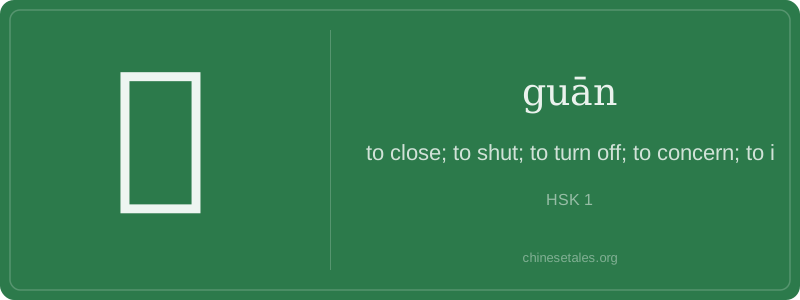
The earliest form of 关 appears in oracle bone inscriptions as two curved strokes resembling a pair of crossed gate bars over a doorway — like an 'X' across an open arch. Over centuries, the top evolved into 丷 (a radical meaning 'split' or 'divided'), symbolizing the dual bars; the bottom simplified from a full gate frame to 口 (kǒu, 'mouth' or 'opening'), representing the portal itself. By the seal script era, the six-stroke structure was fixed: 丷 + 天 (but actually a stylized variant of 口), losing the pictorial gate yet keeping the essence — a visual 'lock' formed by two downward strokes crossing above an opening.
This gate imagery shaped all its meanings: physically shutting a pass (as in 'Jiayuguan Pass'), sealing a container, or turning off a flow — all involve controlling access. In the Classic of Poetry, 关 was used for 'barrier' or 'frontier post'. Later, Confucian thinkers extended it metaphorically: to 'concern oneself' was to draw a moral boundary around someone’s welfare — to take it under your protective gate. Even today, 关心 feels warmer than 'care' because it carries that ancient sense of *deliberate guardianship*, not casual attention.
Imagine you’re in a Beijing hutong on a chilly autumn evening. You hear a soft *thunk* — the heavy wooden door of a courtyard house swings shut, its iron latch clicking into place. That sound and motion is 关 (guān): not just 'close' as a mechanical act, but a gesture that creates boundary, safety, and quiet intention. In Chinese, 关 carries weight — it’s never passive. You don’t 'have the door closed'; you *guān* the door. It implies agency: you actively shut, seal, or turn off — whether a window, a tap, a light, or even a conversation.
Grammatically, 关 is a transitive verb that *requires* an object (you 关 the door, not just 'close'). It also appears in key structures like 关…了 (guān le — completed action) and 关上 (guān shàng — 'shut up/onto', emphasizing direction). Learners often mistakenly use it intransitively ('The door guān') — but no! The door *shàn* (shuts by itself); only *you* can guān it. Also, while 'concern' seems unrelated, think of 'shutting in' attention: 关心 (guān xīn) literally means 'to shut into the heart' — i.e., to care deeply.
Culturally, 关 evokes ancient frontier passes like Jiayuguan — gates that separated 'civilized' China from the steppes. So 'to concern' isn’t vague interest; it’s *taking responsibility*, drawing a line between what’s yours to manage and what isn’t. A common mistake? Confusing 关 with 管 (guǎn, 'to manage') — but 关 is about boundaries and closure; 管 is about ongoing control. Master 关, and you master intentionality in Chinese action.