民
Character Story & Explanation
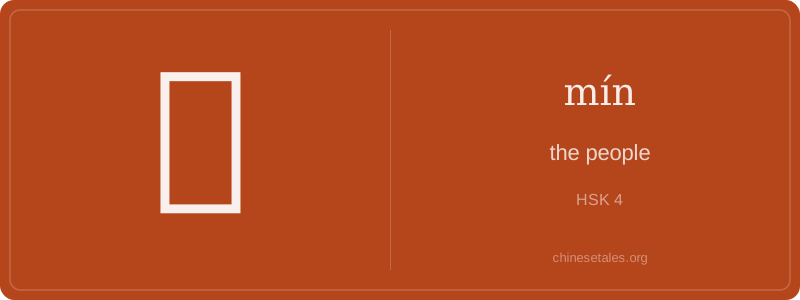
The earliest form of 民 appears on Shang dynasty oracle bones as a striking pictograph: a kneeling figure with a sharp, downward-pointing blade or chisel pressed against the eye — likely depicting a captured prisoner or slave being branded or blinded as punishment. This grim image conveyed subjugation: 'those beneath authority,' i.e., the common populace under royal or aristocratic control. Over centuries, the blade simplified into the top dot and horizontal stroke, the kneeling body became the curved lower part, and the eye morphed into the distinctive hook-like stroke at the bottom — preserving the sense of vulnerability and collective identity without the violence.
By the Warring States period, philosophers like Mencius radically revalued 民: no longer just subjects to govern, but the moral foundation of legitimacy. In the *Mencius*, rulers who lost the people’s trust (失民心) forfeited the Mandate of Heaven. The visual simplicity of the modern five-stroke form — compact, grounded, slightly bowed — echoes that duality: humility and power. Even today, when leaders speak of 民心所向 ('where the people’s hearts turn'), they invoke this ancient, living covenant — written in just five strokes.
At its heart, 民 (mín) means 'the people' — but not as an abstract political concept. It’s the ordinary, working, breathing masses: farmers, artisans, neighbors, citizens. Think less 'citizenry' and more 'folk' — warm, collective, grounded. Unlike 公民 (gōngmín, 'citizen') which implies legal status, 民 carries emotional weight: it’s the 'people' who suffer in war (民不聊生), whose will is sovereign (民心, 'the people’s hearts'), and whose voice must be heard (民意). It’s never used alone as a pronoun ('I' or 'you'); it only appears in compounds or as a noun head.
Grammatically, 民 rarely stands solo — you’ll almost never say *‘mín zài zhèr’* ('the people are here'). Instead, it anchors compound nouns like 国民 (guómín, 'national citizen') or 农民 (nóngmín, 'peasant/farmer'). A common learner mistake is overusing it as a standalone subject — e.g., confusing 民 with 人 (rén, 'person') or 人们 (rénmen, 'people'). Also, avoid mixing it up with 民族 (mínzú, 'ethnic group'): 民 refers to people *within* a polity; 族 refers to shared ancestry or culture.
Culturally, 民 is deeply Confucian and Daoist: Mencius declared ‘the people are most important; the state comes second; the ruler is least important’ (民为贵,社稷次之,君为轻). That radical — the character itself serving as its own radical — signals its foundational role. Learners often miss how tenderly this character can sound: in phrases like 爱民如子 (àimín rú zǐ, 'love the people as one’s own children'), it evokes care, not bureaucracy.