丰
Character Story & Explanation
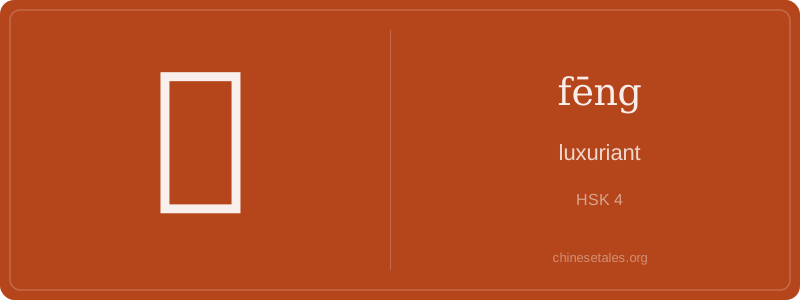
The earliest form of 丰 appears in oracle bone inscriptions as three or four parallel horizontal lines stacked vertically — no vertical stroke yet — resembling dense, layered grain stalks swaying in wind or bundles of harvested cereal tied tightly at the base. By the bronze script era, a strong central vertical line (丨) was added down the middle, anchoring the abundance and turning the image into a stylized sheaf — the very glyph we recognize today: four strokes total (three horizontals + one vertical). That central line wasn’t just structural; it evoked the upright stem holding up the bounty, making the abstract idea of ‘fullness’ physically grounded and vivid.
This visual logic carried straight into meaning: from literal agricultural abundance (harvests, crops), 丰 expanded metaphorically in classical texts like the *Book of Rites* to describe moral richness (德行丰茂, ‘virtue luxuriant and flourishing’) and cultural sophistication (文采丰美, ‘literary style rich and beautiful’). Even today, when Chinese speakers hear 丰, they don’t just think ‘a lot’ — they feel the weight of ripe grain, the quiet pride of a thriving family, the dignified fullness of a life well-lived. Its shape *is* its philosophy: simplicity holding profound plenty.
At its heart, 丰 (fēng) is about abundance that overflows — not just quantity, but lushness, fullness, and vigorous growth. Think of a rice field heavy with golden stalks bending under their own weight, or a fruit-laden branch so thick it dips toward the earth. This isn’t sterile ‘a lot’ — it’s organic, generous, almost celebratory plenitude. In modern usage, it rarely stands alone; instead, it’s the quiet powerhouse inside compound words like 丰富 (fēng fù, ‘rich/abundant’) or 丰收 (fēng shōu, ‘bumper harvest’), where it contributes the core sense of overflowing sufficiency.
Grammatically, 丰 is almost never used as a standalone adjective or verb — unlike English ‘luxuriant’, you won’t say *‘this tree is 丰’*. Instead, it appears exclusively in set phrases and compounds, usually as the first character. Learners often mistakenly try to use it predicatively (e.g., *‘这个花园很丰’*), but that’s ungrammatical — it must be paired: 丰富多彩 (colorful and rich), 丰盛 (plentiful, especially for food), 丰满 (full-figured or well-developed). Its role is semantic glue, not syntactic soloist.
Culturally, 丰 carries warm, auspicious weight — it’s deeply tied to agrarian prosperity and Confucian ideals of flourishing virtue. You’ll see it in Spring Festival couplets wishing ‘五谷丰登’ (wǔ gǔ fēng dēng, ‘five grains abundant and harvested’), symbolizing national stability. A common mistake? Confusing it with 封 (fēng, ‘to seal’) or 升 (shēng, ‘to rise’) — visually similar but semantically worlds apart. Remember: 丰 is about *what fills*, not what closes or climbs.