倒
Character Story & Explanation
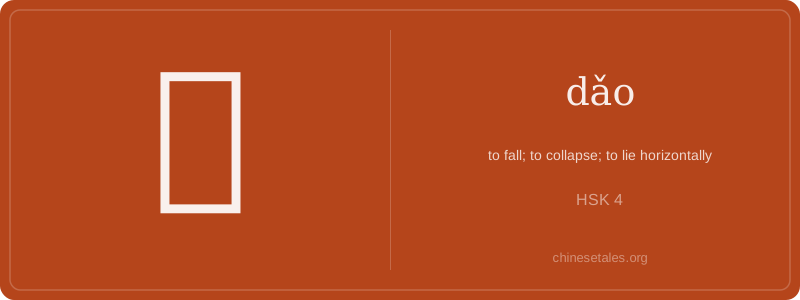
The earliest form of 倒 appears in bronze inscriptions as a stylized figure with arms flung wide and head tilted sharply downward — unmistakably a person losing balance. Over centuries, the ‘person’ element solidified into the left-side 亻 radical, while the right side evolved from a simplified depiction of a bent body + a descending stroke (the ‘falling’ component) into today’s 刂 (knife radical) + 一 (horizontal line), now read as ‘dǎo’. Crucially, the 10 strokes include two key visual cues: the slanting 亻 leaning left (imbalance), and the downward stroke at the end of 刂 — like a final descent.
This pictographic origin explains why 倒 never meant ‘to stand up’ or ‘to rise’ — its essence is irreversible downward movement. In the Classic of Poetry, 倒 is used in phrases like ‘墙倒屋塌’ (qiáng dǎo wū tā, ‘walls fall, houses collapse’), emphasizing structural failure. Even today, its shape feels unstable: look closely — the 亻 leans, the right side ends with a sharp downward cut (刂), and the whole character seems to tilt slightly leftward on the page, visually echoing its meaning.
Think of 倒 (dǎo) as the ‘gravity character’ — it’s all about things surrendering to downward force: a person collapsing, a building toppling, or even your carefully stacked books tumbling off the shelf. The radical 亻 (person) on the left tells you this is human-scale action — not abstract collapse, but something visceral and physical. When used as a verb, it’s often intransitive (no object needed): ‘The tree fell’ = 树倒了 (shù dǎo le), where the -le signals completion. Notice how the ‘fall’ isn’t just motion — it implies finality, irreversibility, even loss of control.
Grammatically, learners often overuse 倒 when they mean ‘to pour’ or ‘to reverse’ — those are the *other* pronunciation, dào (e.g., 倒水 dào shuǐ). With dǎo, there’s no intentionality — it’s passive, sudden, and usually unplanned. Also, avoid saying ‘他倒了’ for ‘he fainted’ without context; native speakers often add nuance like 昏倒 (hūn dǎo, ‘faint’) or 摔倒 (shuāi dǎo, ‘trip and fall’) to clarify cause.
Culturally, 倒 carries subtle weight: in classical texts, 倒戈 (dǎo gē, ‘turn one’s spear’) meant betrayal — literally reversing your weapon against your own side. And in modern slang, 倒霉 (dǎo méi, ‘bad luck’) evokes misfortune that strikes *down* upon you, like a falling roof tile. The character doesn’t judge — it simply records gravity’s verdict.