停
Character Story & Explanation
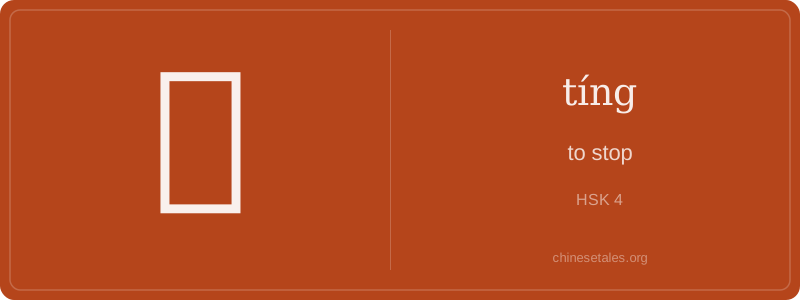
Oracle bone inscriptions don’t show 停 directly, but its ancestor is clear: the character 亭 — a pictograph of a raised, roofed structure with pillars, drawn as a simple square-on-stilts (⿱高 + 丁 in early forms). By the Warring States period, scribes added the 亻 radical to emphasize *who* uses the pavilion: travelers, messengers, soldiers — people who *stop*. Over centuries, the pavilion’s stylized roof and pillars condensed into the modern 亭 component: the top dot (丶) became the roof peak, the horizontal strokes formed eaves, and the vertical stroke with hook (丨+亅) evolved into the base. Meanwhile, 亻 stayed firmly on the left — no mistaking the human element.
This visual logic shaped meaning deeply: in classical texts like the *Zuo Zhuan*, 亭 wasn’t just architecture — it was administrative infrastructure where officials halted to inspect roads or collect taxes. So 停 inherited that sense of *purposeful pause*: not idleness, but strategic interruption. Even today, when we say 停電 (‘power outage’), it’s not random failure — it evokes the image of electricity *intentionally halted*, like a courier pausing at a checkpoint before continuing his route.
At its heart, 停 (tíng) isn’t just ‘to stop’ — it’s the deliberate, often temporary, suspension of motion or action: a car halting at a red light, a speaker pausing mid-sentence, or a factory line idling. The 亻 (rén) radical signals human agency — this isn’t passive cessation (like 死 ‘to die’) but an intentional act by a person or system. The right side, 亭 (tíng), is both phonetic *and* semantic: ancient 亭 were roadside pavilions where travelers paused to rest — literally ‘stopping places’. So 停 visually and etymologically means ‘a person stopping at a pavilion’.
Grammatically, 停 is versatile: as a verb, it takes objects (停車 ‘stop the car’), appears in aspectual constructions (停了 ‘has stopped’), and forms common result complements like 停下來 (‘stop [and come to rest]’). Learners often wrongly use it for permanent endings (use 結束 or 終止 instead); 停 implies reversibility — you can restart. Also, it rarely stands alone in commands; say 停下!(‘Stop!’) not just 停!— the complement adds urgency and physicality.
Culturally, 停 carries quiet authority: traffic signs say 停 (STOP), not 等 (wait) — it’s non-negotiable. And in formal contexts, 停職 (tíngzhí, ‘suspension from duty’) implies disciplinary pause, not termination. A classic mistake? Confusing it with 聽 (tīng, ‘to listen’) — same sound, totally different realm. Remember: 停 has legs (亻), not ears (耳).