傅
Character Story & Explanation
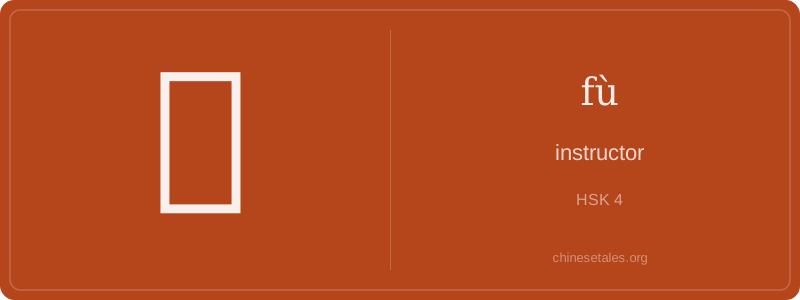
The earliest form of 傅 appears on Warring States bamboo slips: left side 亻 (person), right side 尃 — a variant of 專 (zhuān, ‘to concentrate’), which itself evolved from a pictograph of a hand holding a spindle, symbolizing focused, skilled labor. Over time, 尃 simplified to 甫 — a component meaning ‘beginning’ or ‘in full bloom’, reinforcing the idea of nurturing potential. The 12 strokes crystallized by the Han dynasty: two dots above 甫 represent ritual purity or scholarly distinction, while the 亻 radical anchors it firmly in human relationship — not abstract instruction, but embodied guidance.
This visual logic mirrors its semantic journey: from Shang-Zhou ‘ritual attendant who prepared nobles for ceremony’ → Warring States ‘personal tutor to princes’ → Han dynasty ‘one of the highest civil offices’ (e.g., 太傅, Grand Tutor to the Emperor). In the Book of Rites, it’s written that ‘the 傅 observes conduct, corrects demeanor, and guards virtue’ — highlighting its ethical guardianship role. Unlike modern teachers, the 傅 was less about knowledge transmission than moral formation — a living compass for elite identity.
Imagine a quiet study hall in Tang-dynasty Chang’an, where a young scholar bows deeply before an elderly man holding a bamboo scroll — not his father, not his official superior, but his fù: a personal tutor entrusted with shaping his character, ethics, and classical knowledge. That’s the soul of 傅: not just ‘teacher’ (which is 老师), but a revered, one-on-one mentor — often aristocratic, sometimes familial (like a ‘tutor to the crown prince’), always steeped in moral authority. It carries gravitas, formality, and deep respect.
Grammatically, 傅 is almost never used alone. You’ll see it only in compound nouns like 太傅 (imperial tutor) or as part of titles — never in phrases like ‘I am a fù’ (that’s 老师 or 教师). Learners often mistakenly use it as a general word for ‘teacher’ — a subtle but serious faux pas, like calling your high-school math teacher ‘Your Excellency’. Also note: 傅 is *never* a verb — you don’t ‘fù someone’; you ‘teach’ (教) or ‘mentor’ (指导).
Culturally, 傅 evokes Confucian hierarchy and elite education — think of the Three Ducal Ministers (三公), where 太傅 ranked highest among them. Even today, its presence signals prestige: a university president might be honored as 校傅 in ceremonial contexts (though rare), and in historical dramas, characters address their tutors as ‘Xīn Fù’ (‘Esteemed Tutor’) — a title dripping with deference. Mistake this for 赋 (fù, ‘rhapsody’) or 付 (fù, ‘to pay’), and you’ll conjure poetry or invoices instead of wisdom.