傲
Character Story & Explanation
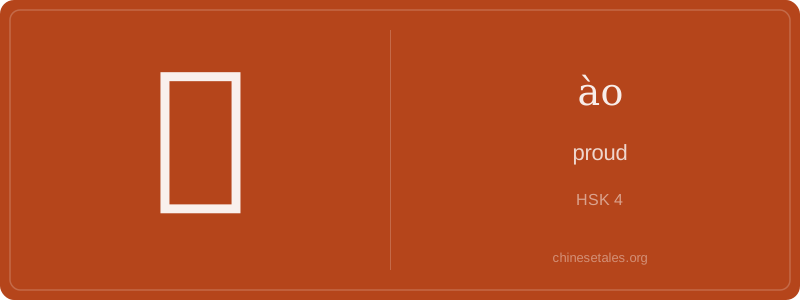
The earliest form of 傲 appears in bronze inscriptions as a composite: the left side was the 'person' radical (亻), and the right was 吾 — a phonetic component meaning 'I/me,' but also pictographically suggesting a mouth (口) above a spear-like weapon (五 evolved from a stylized weapon shape). Over centuries, 吾 simplified into the modern 右-hand structure ( + 夂), while the person radical stabilized. Crucially, the original seal script form emphasized verticality — three distinct upward strokes on the right side — evoking a person standing tall, unbent, even defiant. The 12 strokes weren’t arbitrary: they map the physical stance — head held high (the dot and horizontal), spine erect (the vertical stroke), arms crossed or akimbo (the angled hooks and sweeps).
This visual logic shaped its semantic journey. In the *Zuo Zhuan*, 傲 first appeared describing rulers who 'disdained counsel' — their physical bearing mirrored their moral posture. By the Tang dynasty, poets like Li Bai used 傲 to capture rebellious individualism: '安能摧眉折腰事权贵,使我不得开心颜?' — though he didn’t use 傲 explicitly, his spirit is pure 傲然. The character’s enduring power lies in that fusion: every stroke enacts resistance — not loud anger, but silent, rooted, unassailable height. Its form *is* its meaning: a human figure refusing to shrink.
Think of 傲 (ào) as the Chinese cousin of the Greek concept of 'hubris' — not just pride, but pride that swells so high it risks toppling over into arrogance or defiance. In English, 'proud' can be warm and positive ('I’m proud of you'), but 傲 almost always carries a subtle edge: it’s the pride of someone who stands apart, chin up, shoulders back, unyielding — sometimes admirably, sometimes dangerously. It rarely appears alone; instead, it glides into compounds like 傲慢 (àomàn, 'arrogant') or 傲然 (àorán, 'haughtily upright'), where it functions adjectivally or adverbially — never as a verb like 'to pride oneself.' You won’t say *'tā ào le'* — that’s grammatically off. Instead, it modifies nouns ('an arrogant attitude') or describes posture and demeanor ('stood aloof').
Grammatically, 傲 is a classic 'stative adjective' — it behaves like an adjective but doesn’t take 得 for complements (no *'ào de hěn'*), and it’s rarely used predicatively without a modifier. Learners often mistakenly try to use it like 自豪 (zìháo, 'proud' in a positive, self-affirming sense), but 傲 lacks that warmth. Saying *'wǒ hěn ào'* sounds odd or even hostile — like declaring 'I am haughty' rather than 'I’m proud.' Native speakers reach for 自豪 or 骄傲 (jiāo'ào) when praising achievement; 傲 stays reserved for literary, critical, or descriptive contexts — especially when highlighting distance, resistance, or unbroken spirit.
Culturally, 傲 has a fascinating duality: it’s both condemned (as in Confucian warnings against arrogance) and quietly admired (as in the stoic resilience of scholars facing exile). In classical poetry, 傲 often appears with natural imagery — '傲雪凌霜' (àoxuě língshuāng, 'defying snow and frost') — transforming pride into moral fortitude. This layered resonance means learners must read tone and context carefully: is this character scolding or saluting? That ambiguity — proud vs. prickly, noble vs. nasty — is precisely what makes 傲 so rich and so tricky.